
Horse-assisted offers on Mallorca, what is behind them and what the research says
Horses on Mallorca are not only sport partners. On the island there are fincas that offer encounters with horses to slow down, understand oneself better or close the year. Very different things stand behind this, and the terms are often mixed up. This text separates them, summarises what review studies say about effectiveness, and shows how to place an offer. At the end there is a concrete example: the Closing Circle at Finca Son Cavalls near Felanitx on 13 December 2026.
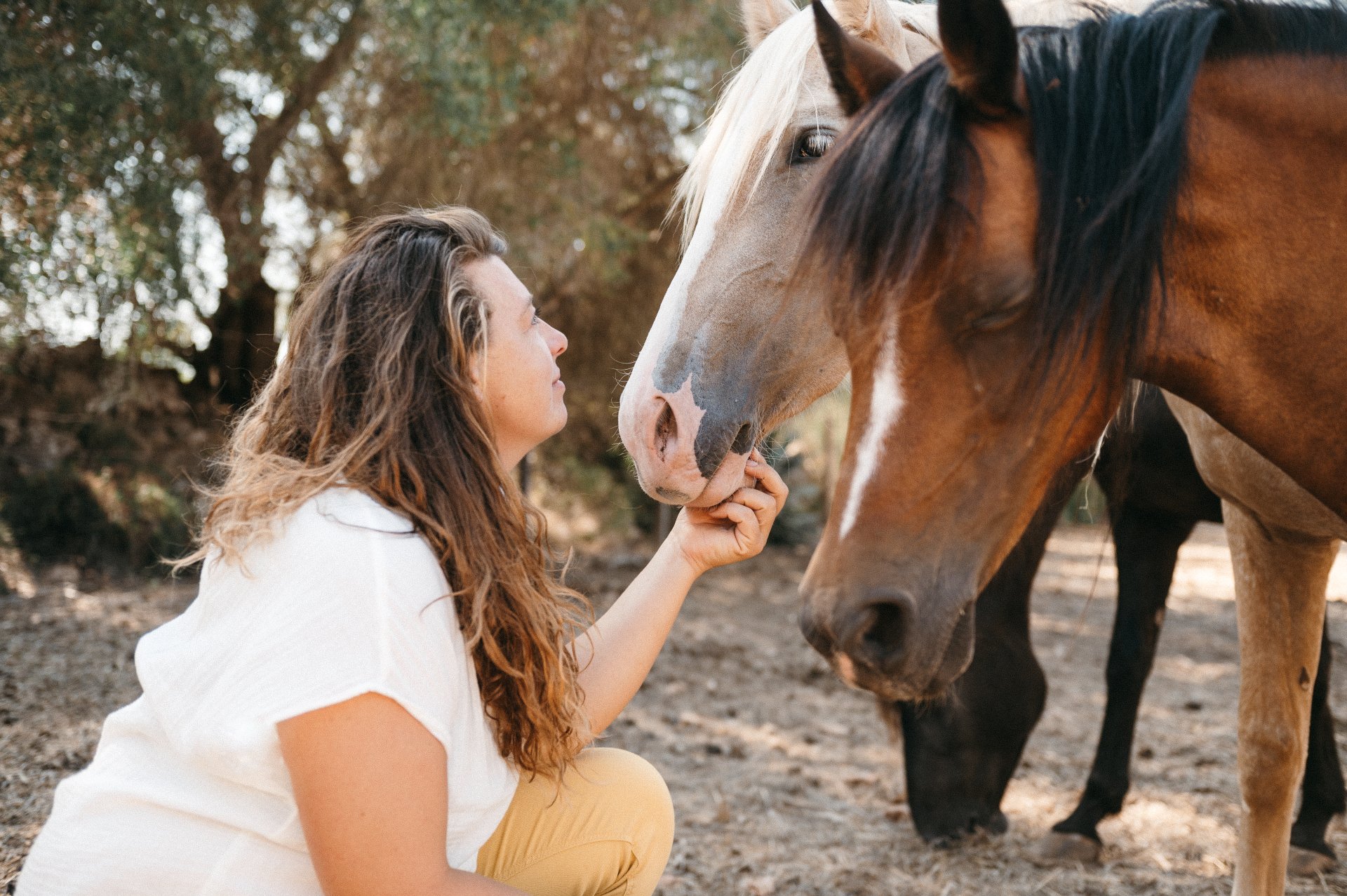 Photo: Son Cavalls
Three things worth keeping apart
Therapy by professionals. This includes hippotherapy and therapeutic riding, which are anchored in health or educational professions. The Complutense University of Madrid describes hipoterapia as physiotherapeutic and psychomotor treatment with a neurological basis, in which the patient does not steer the horse. It describes equitación terapéutica as psychosocial treatment with or on the horse, with more weight on psychology and education. One example of ground-based work with a therapeutic claim is the Eagala model, which describes itself as an equine psychotherapy model: by its own account it works exclusively on the ground, with a team of a mental health professional and an equine specialist.
Coaching and personal development with horses. The focus is self-awareness, decisions or leadership, not the treatment of an illness. The work often takes place on the ground, without riding.
Encounter without a claim. Time with horses, without anyone promising therapy or coaching: arriving, observing, being open to the moment. That can feel good, but it is neither treatment nor method.
The difference matters because it decides what you may expect and who should be qualified for it. An offer that calls itself coaching or encounter is not therapy. And the other way round: anyone who says therapy should be able to name the qualification for it.
What the studies say
The evidence on horse-assisted interventions is mixed. Review studies describe possible effects, but almost always name the same limits: small samples, few randomised studies, risk of bias, inconsistent terms and measures, rarely any follow-up.
- Overview. An umbrella review (Stern and Chur-Hansen, 2019) assessed, according to the summary of the Australian Psychological Society, 13 systematic reviews with 79 individual studies. The authors considered the studies so flawed that no supporting conclusions for horse-assisted interventions could be drawn from them.
- Children and young people. A meta-analysis (Fuller-Lovins and colleagues, 2023) pooled 16 controlled studies with 1,009 participants and found a medium overall effect on psychosocial outcomes. Self-esteem and depressive symptoms were not significant when looked at separately. The authors call for larger samples and better comparison groups.
- Autism. A systematic review with meta-analysis (Xiao and colleagues, 2023) of 25 studies, 8 of them randomised, with 623 participants found significant effects in some areas, such as social communication, and none in others. For motor and sensory outcomes there were not enough comparative data. The authors state that none of the 25 studies had a low risk of bias.
- Stress, anxiety, mood. A systematic review (Kapteijn and colleagues, 2025) with 31 studies reports that all quantitative studies found at least one positive effect, and at the same time writes that well-designed studies were sparse. For veterans with post-traumatic stress disorder, a meta-analysis (Provan and colleagues, 2024, 13 studies, 344 participants) found lower symptom scores on average, but the authors consider almost all studies to be of low quality and urge caution. A narrative review (Marchand and colleagues, 2021) sees them as a possible complement and calls for rigorous studies before firm statements are possible.
- Motor function in children with cerebral palsy. A review of hippotherapy (Bernardino and colleagues, 2025, 25 studies, 602 children) concludes that gross motor function improves, but rates the quality of the studies as only moderate: small samples, mostly no blinding. A meta-analysis (Stergiou and colleagues, 2025) found significant effects only for individual outcome measures, for example walking, running and jumping in children with cerebral palsy and the Timed Up and Go test in older people and after stroke.
- Coaching and learning with horses. The evidence is particularly limited here, see below.
So studies report effects, and the evidence is limited and mixed. That applies most where the subject is not movement but mind and personality. It is also not proven that such offers are better than established treatments.
The horse is not a tool
A second point that is often missing: the welfare of the animals. A comparative analysis of the manuals of several models (Kieson and Abramson, 2017) criticises that there are no common standards for understanding horse behaviour, and names possible signs of overload in therapy horses, for example flight behaviour. The authors did not observe horses for this, they rely on materials from the associations. The European association ESAAT calls animal welfare an indispensable condition for accredited training. For visitors this means: pay attention to how the horses live, how people handle them and whether they are allowed to withdraw.
How to place an offer
These are our questions, not standards from a source:
- What does the provider itself call the offer? Therapy, coaching, encounter, experience. The term tells you what to expect.
- Which qualification is named? In so many words, with training or association, not just a feeling. For therapy it should be unambiguous.
- What is promised? Be careful with promises of healing. Serious offers say what they are and what they are not.
- How do the people treat the horses? Calmly, with a way for the animals to withdraw?
- How do you stay safe around horses? Ask about a briefing and the group size.
A horse-assisted offer does not replace psychotherapy or medical treatment. If you suffer from a mental illness or are in a crisis, turn to a professional.
On Mallorca
On Mallorca there are horse-assisted offers of very different kinds. In the Mallorca Hub you will find independent editorial profiles of businesses that offer stays and experiences with horses, for example Son Cavalls near Felanitx and Ànima Lliure. The Son Cavalls profile carries the note “Independent editorial profile, no compensation” (as of September 2026).
On its own website Son Cavalls describes its offer as coaching, horse experiences and encounter. A format called “Pferdegestützte Therapie” (horse-assisted therapy) is also listed there. As qualification the site names further training in applied human and equine psychology, and it names no certificates or associations. According to the profile the work takes place mostly on the ground, riding experience is not needed.
Two examples, Herd Experience on 6 December and Closing Circle on 13 December
At Finca Son Cavalls the provider announces two dates for December. The details come from the organiser in each case, the Herd Experience from its Instagram post and poster as of 15 November 2026, the Closing Circle from its posters as of 13 November 2026.
Herd Experience, Three hours with our herd
- When: Sunday, 6 December 2026, 10:30, about 3 hours
- Where: Finca Son Cavalls, Felanitx
- Programme: First arrive and watch the horses in their natural presence, then a mindful contact without words with body language at the centre, and to finish a shared drink under the open sky.
- Requirements: no riding experience, no prior knowledge needed
- Places: limited, the group is deliberately small
- Booking: by e-mail to info@soncavalls.es or by phone on +34 664 873 546, more at soncavalls.es
Son Cavalls answers questions about the price and the programme. You will find more information and the entry in our calendar here: Herd Experience at Son Cavalls
The Closing Circle at Finca Son Cavalls is not therapy. The provider does not describe it that way and neither do we. It is a year-end gathering with horses, nature and fire. The following details come from the organiser, from the posters (flyers) of Son Cavalls, as of 13 November 2026:
- When: Sunday, 13 December 2026, 10:30, about 3 hours
- Where: Finca Son Cavalls, Felanitx
- Programme: First participants and horses meet without expectations, then the day winds down at the fire, with room to talk and a small ritual to close the year. The Spanish and English posters put it as: first the horses, then the fire, look back honestly, find your direction and write the resolutions afterwards.
- Places: limited
- Booking: by phone +34 664 873 546 or by e-mail to info@soncavalls.es (details as on the flyer), more at soncavalls.es
Son Cavalls answers questions about the price and the programme. Further information and the entry in our calendar: Closing Circle at Son Cavalls
Whether a morning like this or a year-end gathering like this is right for you does not depend on the state of the studies. They are offers for people who look for time with horses, not a promise.
1. Stern C, Chur-Hansen A: An umbrella review of the evidence for equine-assisted interventions, Australian Journal of Psychology 2019;71(4):361-374, DOI 10.1111/ajpy.12246. Read via the summary of the Australian Psychological Society, psychology.org.au (April 2019), accessed 13 November 2026.
2. Fuller-Lovins S et al.: The Effectiveness of Equine-Assisted Mental Health Interventions for Youth, Adolescent Research Review 2023, DOI 10.1007/s40894-023-00209-9 (abstract, bearworks.missouristate.edu), accessed 13 November 2026.
3. Xiao N et al.: Effects of Equine-Assisted Activities and Therapies for Individuals with Autism Spectrum Disorder, Int J Environ Res Public Health 2023;20(3):2630, pmc.ncbi.nlm.nih.gov, accessed 13 November 2026.
4. Kapteijn C et al.: Are equine assisted interactions a dark horse bet?, Psychiatry and Clinical Psychopharmacology 2025;35:90-112, DOI 10.5152/pcp.2025.24958 (abstract), accessed 13 November 2026.
5. Provan M et al.: Are equine-assisted services beneficial for military veterans with PTSD?, BMC Psychiatry 2024;24:544, DOI 10.1186/s12888-024-05984-w (summary via Europe PMC), accessed 13 November 2026.
6. Marchand WR et al.: Equine-Assisted Activities and Therapies for Veterans With PTSD, Chronic Stress 2021;5, pmc.ncbi.nlm.nih.gov, accessed 13 November 2026 (beginning read).
7. Bernardino I et al.: Hippotherapy Improves Gross Motor Function in Children with Cerebral Palsy, NeuroRehabilitation 2025;57(4):489-503, DOI 10.1177/10538135251387278 (abstract), accessed 13 November 2026.
8. Stergiou AN et al.: Effects of Equine-Assisted Therapy, J Clin Med 2025;14(11):3731, DOI 10.3390/jcm14113731 (abstract), accessed 13 November 2026.
9. Kieson E, Abramson CI: Equines as Tools vs Partners, Journal of Veterinary Science and Animal Husbandry 2017;5(1):107, DOI 10.15744/2348-9790.5.107, accessed 13 November 2026.
10. Universidad Complutense de Madrid, Hipoterapia, ucm.es (undated), accessed 13 November 2026.
11. Eagala, About, eagala.org (undated, self-description), and ESAAT, esaat.org (home page), both accessed 13 November 2026.
12. Son Cavalls, soncavalls.es (home page, neustart, workshops, location), accessed 13 November 2026. Organiser’s posters for the Closing Circle (DE, ES, EN), as of 13 November 2026. Instagram post and poster of the organiser for the Herd Experience, as of 15 November 2026.