Horse Hoof Care: What Owners Should Actually Know
“No foot, no horse” holds up.
Recognising a balanced foot, keeping the cycle, and telling a farrier problem from a vet problem makes a real difference.
A hoof capsule takes nine to twelve months to grow from coronet to ground.
The parts you should be able to name
The foot is the part of the horse that most rewards a small amount of regular attention and most punishes neglect. It is also the part owners most often hand over entirely, to a farrier who visits for forty minutes every six weeks and is otherwise not there. That handover is fine for the trimming itself. It is not fine for the other forty-one days, when the person who sees the horse every day is the one who can catch a stretched white line, a bruise, a change in how the foot lands, or the bounding pulse that means something is wrong. This is what to look for, and what it means.
You cannot describe a problem you have no words for, and you cannot notice a change in a structure you have never looked at. A working owner’s vocabulary of the foot does not need to be a vet’s, but it needs to cover the visible ground.
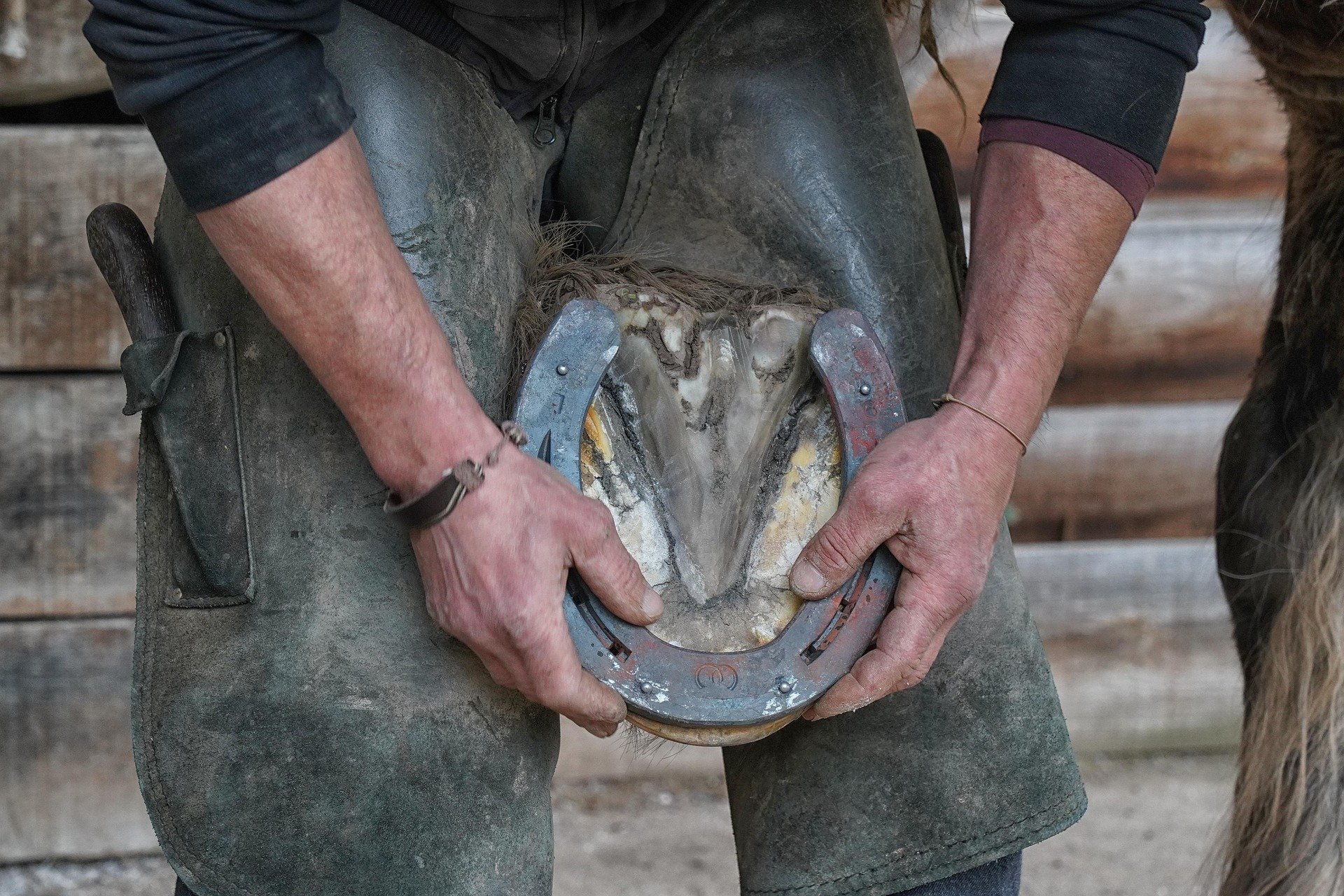
From underneath: the wall is the hard outer rim that meets the ground, the sole is the slightly domed plate inside it, the frog is the rubbery V pointing forward from the heel, the bars are the two ridges that fold in from the heel alongside the frog, and the white line is the pale junction between wall and sole, the seam where wall separation and disease show up first. At the back, the two soft heel bulbs sit above the frog. Around the top, where hair meets horn, is the coronet band, every millimetre of wall is grown there and takes months to reach the ground.
Inside the capsule, three things matter to an owner. The pedal bone (also called the coffin or distal phalanx), sits within the hoof, roughly mirroring its external shape. It is slung from the inside of the wall by interlocking sheets of tissue, the laminae (the structures that fail in laminitis). And the back third of the foot, frog, digital cushion and lateral cartilages, is the shock-absorbing, blood-pumping apparatus that a healthy foot relies on and a contracted or long-shod one uses less.
Why the cycle is four to eight weeks
Hoof wall grows from the coronet at roughly 6 to 10 mm a month, faster in a young horse and in the growing season, slower in a veteran or in hard weather. Growing an entire new capsule from coronet to ground takes something like nine to twelve months at the toe, and longer at the heel. That number is worth holding onto, because it means every change you make to a foot (a supplement, a new trim approach, a move to barefoot), is judged over seasons, not weeks.
In a horse living out on soft ground with light work, the wall wears about as fast as it grows and a trim can sometimes stretch to eight or even ten weeks. In almost every other case (a shod horse, a horse in regular work, a horse on ground that does not wear the foot), the wall grows faster than it wears, and left alone the foot simply gets longer and, as it does, distorts. The toe runs forward, the heels collapse under and forward, the hoof-pastern angle breaks backward, and flares open up in the wall. Most working horses hold their balance best on a four-to-six-week cycle. Six to eight is the outer edge for a barefoot horse with good feet.
The trap is waiting until the foot “looks like it needs doing.” By the time the length is obvious, the damage is already in the angles and the leverage, and the farrier is correcting rather than maintaining. A cycle you keep to the calendar beats one you judge by eye.
The foot usually tells you before the calendar does, if you know what to look for. On a shod horse: risen clenches (nail ends standing proud as small bumps), a shoe that has shifted or sprung away from the wall, or wall grown out past the shoe’s edge so the horse is effectively standing on the rim of an old shoe set too far in. On a barefoot horse: chipping or cracking at the toe and quarters, a flare opening low on the wall, or footiness on ground the horse normally handles without trouble. A thrown shoe is often the interval telling you, after the fact, that it ran a week too long.
What a balanced foot looks like
Measuring angles isn’t necessary. Knowing what your own horse’s feet normally look like, from two viewpoints, well enough to notice when that changes, is.
From the side, the front of the hoof wall should run roughly parallel to the front of the pastern, a straight, continuous line from fetlock to toe. If the toe is long and the heel is low and crushed forward, that line breaks backward at the coronet: a broken-back hoof-pastern axis, which loads the back of the foot, the navicular region and the deep flexor tendon, and is the single most common distortion in domestic horses. The opposite, a broken-forward axis from too much heel, is less common but also worth spotting.
From the front and from behind, the foot should look symmetrical either side of an imaginary centre line, the two heels the same height, and the horse should land flat or very slightly heel-first rather than stabbing down on one side. Add to that the things that show up in the wall itself: flares where the wall bulges out at the bottom, dishing or a concave curve to the toe, hard horizontal rings, and a white line that looks stretched, widened or blood-marked. None of these is a diagnosis on its own. All of them are reasons to ask the farrier a question at the next visit.
- ✓ Side: hoof-wall line continuous with the pastern, not broken back at the coronet
- ✓ Side: heel under the limb, not run forward, toe not obviously long
- ✓ Front: symmetrical left and right of centre, heels level
- ✓ In motion: lands flat or slightly heel-first, not to one side
- ✓ Wall: no new flare, dish, ring or stretched white line since last look
- ✓ Photograph the feet the day after a trim. That is your reference for “normal”
Barefoot or shod: an honest answer
The honest answer is that it depends. Here is the trade-off as clearly as it can be put.
A shoe protects a foot that cannot keep up with the wear its work demands, adds grip on roads and in competition, and gives a farrier something to nail corrective support to when a foot has a genuine pathology. The cost is that a nailed shoe loads the hoof around its outer rim rather than across the whole sole, damps down the natural flex and blood-pump of the foot, and over years is associated with narrower frogs, weaker digital cushions and more under-run heels.
Barefoot lets the entire foot function as designed, and many horses genuinely grow a better foot without shoes (steeper heel angles, a wider frog, a thicker sole, better pedal-bone alignment show up in the research comparing the two). But it is not a default you can simply switch to. It asks for reasonable genetics, a consistent and skilled trim, enough movement to condition the foot, ground the horse can cope with, and often hoof boots for roadwork or stony hacking, and a horse shod continuously for years may take months to transition, or may never fully manage it.
Large, long-term evidence tying either choice to a clear welfare outcome does not exist. So the decision is a practical one, made case by case, not a rule to apply.
This horse, this work, this ground, and the standard of hoof care you can actually get where you keep it.
The problems to catch early
Five foot problems make up most of what an owner will actually meet. Knowing the early signs is the difference between a management note and a lame horse.
Thrush
Black, foul-smelling frog, deep grooves either side and up the middle. Wet, dirty standing plus feet not picked out. Usually managed with cleaning, dry footing and a topical, but neglected, it eats into sensitive tissue.
Hoof abscess
Sudden, near non-weight-bearing lameness, a strong bounding digital pulse, heat in one foot, often days after wet-then-dry ground. Dramatic out of all proportion to the fix: drained, it improves fast.
White line disease
Powdery, crumbling separation running up the wall from the white line, packing with grit and muck. Often no lameness until it is advanced, which is why it is worth looking for. Needs resection and a dry environment.
Cracks
Shallow surface “grass” cracks are common and mostly cosmetic. Full-depth cracks from the coronet down move as the horse loads the foot and need active stabilising before they worsen.
Bruised sole / corn
Red-purple staining in the sole or at the heel angle, short-striding on hard or stony going. Thin soles and stretched shoeing intervals make it more likely. Often a sign the foot needs more protection or a shorter cycle.
The digital pulse, and other checks
A few things tell you a lot about a foot and need no equipment. The most useful is the digital pulse, felt with two fingers over the blood vessels that cross the back of the fetlock or run down the side of the pastern. In a sound, comfortable foot it is faint or hard to find. Learn that faint normal on your own horse when nothing is wrong, so that a strong, bounding pulse (which signals inflammation somewhere below it), actually registers as abnormal when you feel it.
Alongside it: compare the temperature of the hoof capsule between feet with the back of your hand (one hot foot points at a problem in that foot. All four warm after standing on hot ground is usually nothing). Watch how the horse stands and moves: pointing a foot, shifting weight, short steps on hard ground.
A horse with heat and a bounding digital pulse in both front feet, standing rocked back onto its heels with the front legs stretched forward, and reluctant to walk, is showing laminitis. Phone the vet now, do not walk the horse around, and keep it still on a soft surface until help arrives. Hours matter.
Feeding the foot, managing the ground
Supplements get more attention than they deserve and management gets less. Biotin at around 15 to 20 mg a day has reasonable evidence for improving horn quality (hardness and wall integrity), in horses that genuinely have poor feet, but only over six to nine months or more, and only in the new growth from the coronet down. It will not rescue a foot this cycle and it will not improve a foot that is already good. It also works best as part of a balanced diet that supplies enough methionine, zinc and copper, not as a lone scoop bolted onto a deficient ration.
The larger levers are dull and free. A consistent trim cycle so the foot never gets far from balance. Turnout and movement, because the foot is built to be loaded and only develops a strong back third if it is used. And standing that is not permanently wet, and not swinging between soaked and bone-dry, it is that wet-dry cycling, more than wet alone, that splits and crumbles horn. Topical hoof oils and dressings have little evidence behind them and mostly change how the foot looks on the day.
Because a whole hoof capsule takes the best part of a year to grow out, judge all of this over seasons. Winter throws its own problems at the foot (soft horn, lost shoes, thrush, deep going), and those are covered in preparing a horse for the colder months.
- ✓ Pick out all four, both sides of the frog and right into the grooves
- ✓ Glance at the white line and frog for black, smell or separation
- ✓ Run a hand down for heat. Feel the digital pulse if anything seems off
- ✓ Check shoes are tight and clenches flat. Note any that have shifted
- ✓ Watch the first few steps out of the stable
- ✓ Anything new and one-sided: call, don’t wait for the next visit
The farrier does the trimming. The forty-one days in between belong to whoever picks the feet out, and that is where problems are caught or missed.
- You don’t need to trim, you need to recognise a balanced foot and keep the cycle. Learn the visible parts so you can describe and notice change.
- Wall grows ~6–10 mm a month. A whole capsule takes 9–12 months. Judge every change to the foot over seasons.
- Most working horses hold balance best on a 4–6 week cycle, 6–8 is the outer edge for a good barefoot horse. Don’t wait until it “looks” long.
- From the side, the hoof-wall line should continue the pastern line. Long-toe / low-heel (broken-back axis) is the common domestic distortion.
- Barefoot vs shod genuinely depends on the horse, work, ground and hoof care available, there is no universal rule and the long-term evidence is thin.
- Learn your horse’s faint normal digital pulse. Bounding pulse + heat in both front feet + rocked-back stance = laminitis = vet now.
- Biotin (15–20 mg/day) helps poor feet slowly and only in new growth. Consistent trimming, movement and stable footing that isn’t wet-dry cycling matter more.
General editorial guidance, not veterinary or farriery advice. Sudden or severe lameness, suspected laminitis or a penetrating foot injury is an emergency, call your vet.
How to Prepare Your Horse for the Colder Months
What Belongs in a Good Grooming Kit?