How Often Should a Horse See the Farrier?
“Every six weeks” is the default, not the rule.
The real interval is set by how fast the foot grows and how fast the work wears it, and both of those move through the year.
Mallorca has fewer farriers, and longer waits, than a comparable mainland area.
The short answer, and why it’s a range
The farrier interval is one of the few pieces of horse management that comes with a number attached, which is probably why the number gets repeated without much thought. Six weeks is a fine starting point for a lot of horses. But a shod competition horse on hard summer ground and an unshod retiree in a soft winter field are not on the same schedule, and the reason they are not is worth understanding, because getting the interval right is cheaper, in every sense, than getting it wrong.
For most horses the farrier comes every four to eight weeks. Where a given horse sits in that range depends on whether it is shod, how much and on what surface it works, the time of year, and the individual foot. A farrier who sets your horse’s interval is not applying a rule. They are reading how much horn has grown and how the balance has changed since last time, and booking the next visit to catch it before it drifts.
Growth: filling the interval from the top
Hoof wall is produced at the coronet at roughly 6 to 10 mm a month and is pushed down towards the ground over the following nine to twelve. That growth rate is not constant. It runs faster in spring and summer, in young horses, in horses on a higher plane of nutrition, and in horses that move a lot. It slows in winter, in older horses, and in a horse on poor feed or confined to box rest.
For a shod horse this is almost the whole story. The shoe stops the foot wearing, so growth is unopposed: the wall lengthens, the toe levers forward, the angles change, and eventually the foot has simply outgrown its shoe. The faster the growth, the sooner that happens. A farrier who knows the horse will adjust the booking to match, week by week, as the season changes.
It is entirely normal for the same horse to be a five-week horse in May and a seven-week horse in January.
Wear: emptying it from the bottom
For a barefoot horse, the other half of the equation matters. On hard, abrasive going, stony tracks, roads, the dry, gritty ground of a Mediterranean summer, a barefoot foot can wear off nearly as much horn as it grows. That horse needs less taken off at each visit, but it still needs the visit, because wear is rarely even and the balance still drifts.
The opposite case catches people out. A horse living on soft ground, stabled a lot, barely ridden, wears almost nothing, so growth wins comfortably and the foot gets long even though the horse “isn’t doing anything.” An unridden horse in a field is not on a longer farrier cycle because it is idle. If anything the lack of movement and wear argues for keeping the cycle regular. “He’s only a companion” is not a reason to stretch the interval to three or four months.
What moves the interval in practice
Four things pull a horse’s interval shorter than the default.
Workload and surface. More roadwork, more competition, more time on hard or abrasive ground means shoes wear thin and work loose faster, and a barefoot foot is challenged harder. A horse hacking on tarmac three times a week is not on the same schedule as one pottering in an arena.
Season. Fast summer growth shortens the shod interval. Slow winter growth can lengthen it, though wet winter ground works the other way for shoe retention.
The individual foot. Thin walls that will not hold a nail for long, a horse that forges or overreaches and pulls its own shoes, a foot that throws flares quickly: all of these can mean a four-week cycle on a horse that “should” be six.
A managed pathology. Navicular changes, laminitis recovery, a corrective shoeing package: here the vet and farrier set a tight interval for a reason, and the single most useful thing an owner can do is keep it to the day.
- ✓ Regular roadwork or competition on hard ground
- ✓ Fast growth: spring and summer, youngstock, good nutrition
- ✓ Thin or weak walls that lose nails early
- ✓ A horse that forges, overreaches or repeatedly pulls shoes
- ✓ Any vet-and-farrier remedial or corrective plan
- ✓ Feet that flare or run forward quickly between visits
Signs you’ve left it too long
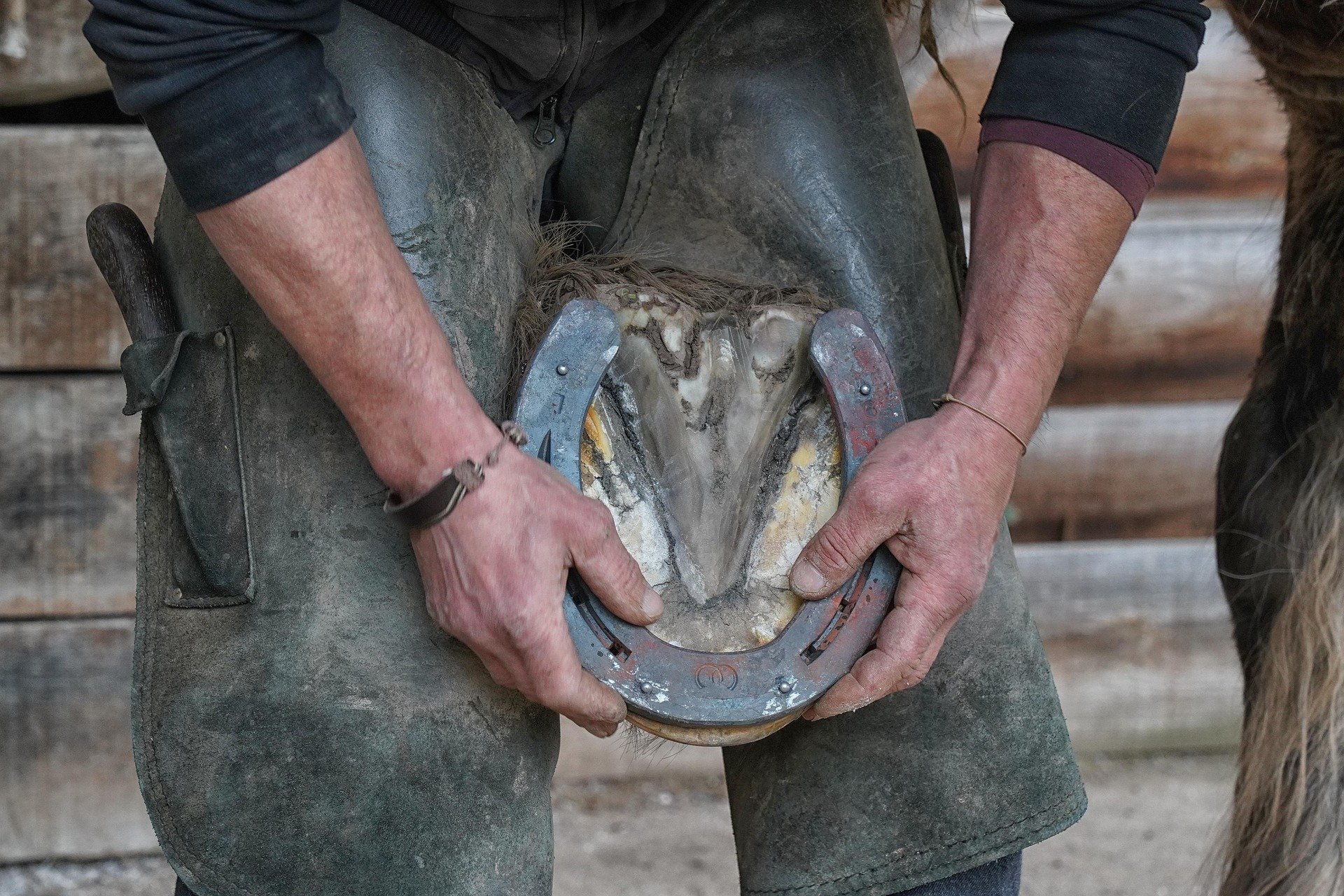
The foot tells you before the calendar does. On a shod horse, run a hand down the wall and feel for risen clenches: the nail ends standing proud as little bumps where the shoe has loosened. Look for a shoe that has shifted, sprung away from the wall or twisted, one worn thin at the toe or along one branch, and the classic overgrown look where the wall has grown out past the edge of the shoe and the horse is, in effect, standing on the rim of an old shoe set too far in.
On a barefoot horse, watch for chipping and cracking at the toe and quarters, a flare opening up low on the wall, and the horse becoming foot-sore on ground it normally copes with. Seen from the side, a long toe with the hoof-pastern line broken backward is a foot well past its trim.
A thrown shoe, more often than not, is the interval telling you after the fact that it was a week too long.
- ✓ Clenches you can feel as bumps on the hoof wall
- ✓ Shoe shifted, sprung, twisted or worn thin
- ✓ Wall grown out over the edge of the shoe
- ✓ Toe and quarters chipping (barefoot)
- ✓ New flare, or a visibly long toe from the side
- ✓ Foot-sore on familiar ground, recently lost a shoe
The lost-shoe clock
Shoe retention is partly about the interval and partly about conditions. Feet that are wet and then soft hold nails poorly. Deep mud creates suction that drags a loose shoe off, and it slows the front feet so a hind can catch and lever one away. A horse moving from hard ground onto deep going changes its stride and is more likely to overreach. In summer, a horse stamping at flies gradually breaks down the horn around the nails.
Most of the prevention overlaps with getting the interval right: do not stretch the cycle during a wet spell, fit overreach or bell boots on a horse that catches itself, keep turnout as dry as the yard allows, and if a shoe does come off, find it and keep it: a horse can tear away a chunk of wall as the shoe goes, and the farrier will want to see how it failed. A horse that reliably loses a shoe around week five is telling you it is a four-week horse, a barefoot candidate, or one that needs a gait and boot conversation.
One thrown shoe is bad luck. Three in a season is a pattern, interval, foot balance, conformation, boots or surfaces, and worth sitting down over with the farrier rather than just re-nailing and hoping.
The scheduling reality
Farrier time is a limited resource, and on an island it is more limited than most. Mallorca has fewer farriers than a comparable mainland area, less price competition, and longer waits for a non-urgent slot, and a shoe thrown late on a Friday can leave you with a footsore horse and no cover until the following week. That reality argues for planning rather than reacting.
The practical answer is to book the next visit before the farrier leaves the yard, hold a standing slot in the diary through the busy season, keep a pair of hoof boots that actually fit for emergencies and stone-bruise days, and treat the farrier as the steady recurring cost it is rather than a surprise: we put rough figures on that in what owning a horse really costs. Stretching the interval to save money is a false economy: it buys remedial trimming, lost shoes, torn walls and missed riding, all of which cost more than the visit you skipped.
The cheapest farrier visit is the one you booked on time. Everything after that, the remedial trim, the lost shoe, the week off, costs more.
- Four to eight weeks covers most horses. Six is a reasonable default. The right number for your horse depends on shoeing, work, surface, season and the individual foot.
- For a shod horse the interval is driven by growth (6–10 mm/month), which is faster in summer and youngstock and slower in winter and old age, so the same horse’s interval changes through the year.
- For a barefoot horse, wear matters too: abrasive ground can self-trim, soft ground and low mileage cannot: an idle horse still needs a regular cycle.
- Roadwork, competition, fast growth, thin walls, shoe-pulling gait and any remedial plan all pull the interval shorter.
- Risen clenches, a shifted or thin shoe, wall grown over the shoe, chipping, new flare or a long toe all mean overdue: book now.
- Lost shoes are worse in wet and deep going. Don’t stretch the cycle in winter, use overreach boots on a horse that catches itself, and keep a thrown shoe for the farrier.
- Book the next visit before the farrier leaves, keep spare hoof boots, and budget farriery as a fixed recurring line: stretching it to save money costs more.
General editorial guidance, not farriery advice. Your farrier sets the interval for your horse. Keep any remedial schedule exactly.
Horse Hoof Care: What Owners Should Actually Know
How to Prepare Your Horse for the Colder Months