Where the Saddle Presses: What a Pressure Mat Shows
A saddle that looks right, sits level and does not slip fits. That is what most of us believe. The measurement is a mat with more than two hundred sensors, and it disagrees more often than saddlers like.
A thin mat between saddle and horse, over two hundred pressure sensors, a Bluetooth link to a laptop, and the ride is drawn as a moving colour map: where the load sits at walk, trot and canter, where it peaks, how it shifts when the rider posts, sits or jumps. Systems such as Pliance have been the research tool of saddle fitting for two decades and are now part of a professional fitting. What the mat measures, the pressure thresholds research has linked to back problems, what the Society of Master Saddlers found when it put mounting from the ground under the mat, why thermal cameras are not the same thing, and what a Mallorca rider can ask for.
The mat shows pressure in motion, which the hand under the panel cannot. It is a fitting tool, not a verdict: the same saddle reads differently with a different rider, pad and gait. Mount from a block. Bridging is the worst fault. Thermography does not measure pressure.
What the mat measures
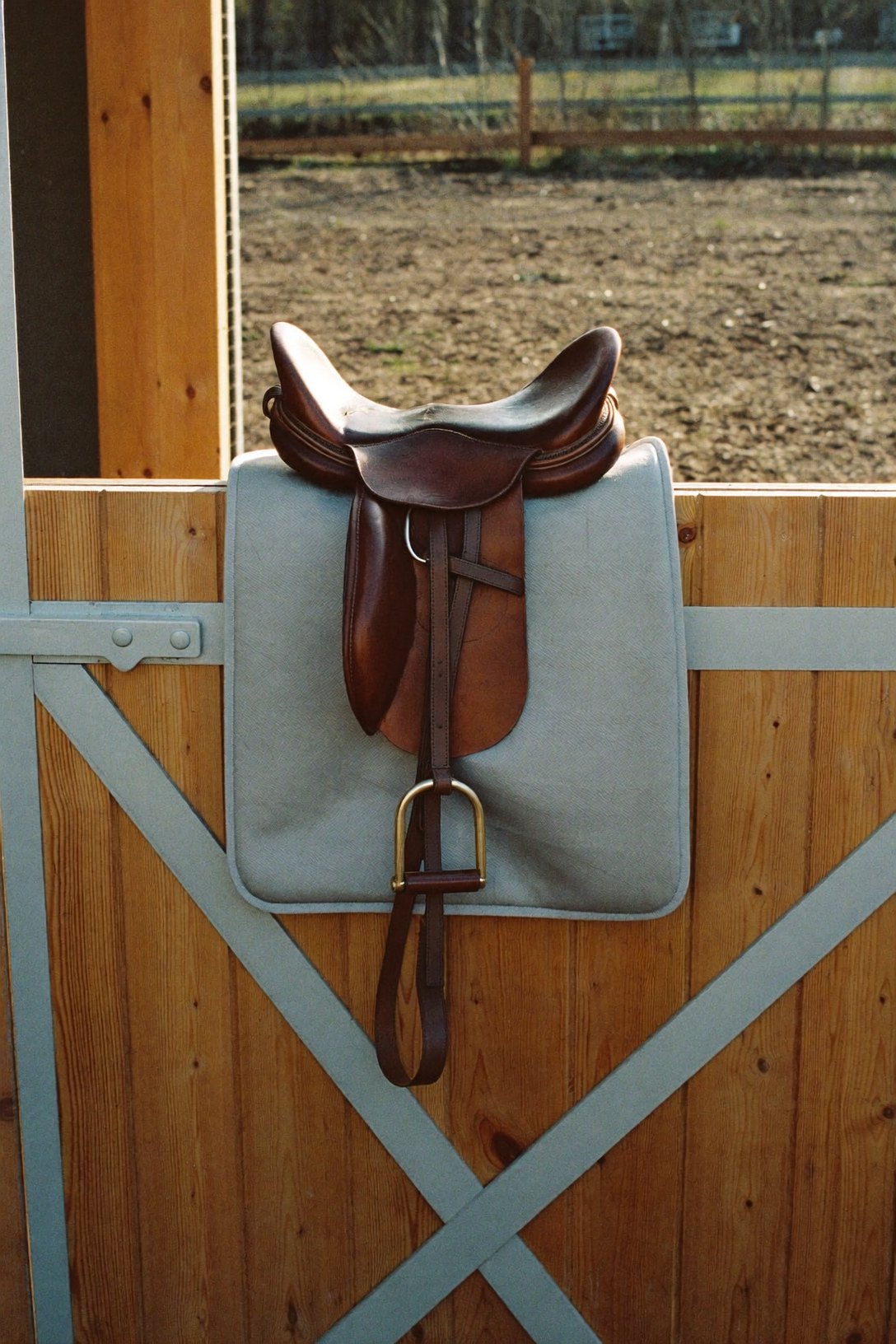
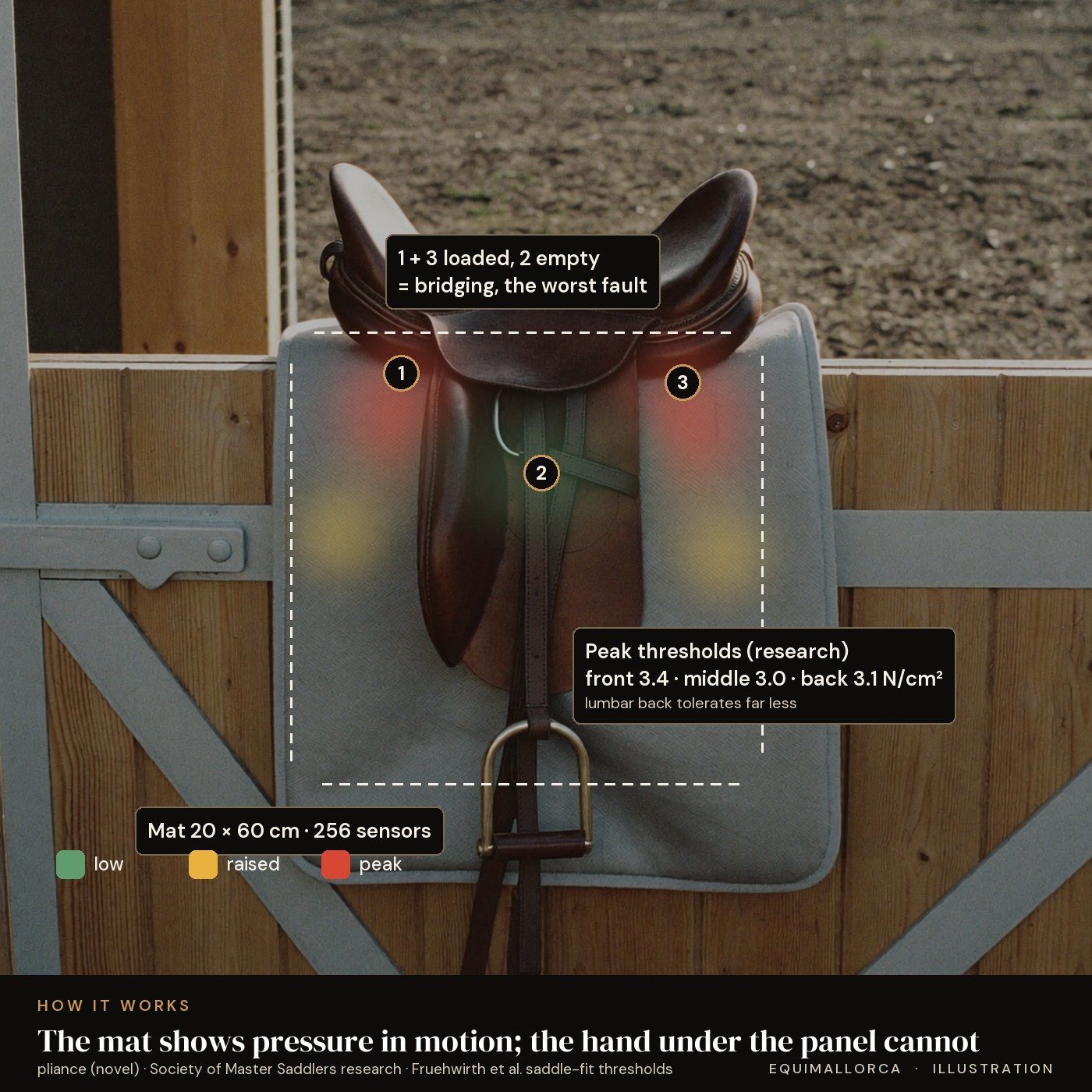
The Pliance system by the German company novel is the reference instrument: a flexible mat with more than two hundred capacitive sensors, laid over the horse’s back under the saddle pad, sampling pressure many times a second and sending it by Bluetooth to a laptop. The software shows three moving graphs and a colour image of the back in which red and pink mark the areas of highest pressure. It records at all gaits and over fences, so the fitter sees what the saddle does when the horse moves, not what it does standing in the yard.
That is the whole point. A saddle that fits the standing horse can bridge, rock or tip forward at canter; a saddle that looks a fraction wide can spread the load beautifully once the back lifts. The hand under the panel, the traditional check, can find a gap or a tight spot on a horse standing still; it cannot see the trot.
The thresholds
Research using pressure mats has put numbers on what a horse’s back tolerates. A frequently cited study of saddle-fit measurement found that peak pressures above roughly 3.4 newtons per square centimetre in the front region, 3.0 in the middle and 3.1 at the back of the saddle area, and mean pressures above about 1.3, 1.1 and 1.0 respectively, were associated with back problems; the lumbar area tolerated far less pressure than the withers region, and bridging, a saddle that bears on front and back while lifting off in the middle, was among the worst faults measured.
These figures are research values, not a certificate. Different systems, pads and calibration produce different absolute numbers, which is why a serious fitting compares saddles on the same horse on the same day rather than quoting one reading against a table.
Bridging was among the worst faults the mat could find. The lumbar back tolerates far less than the withers.
- pliance saddle mat (novel) · flexible mat 20 × 60 cm with 256 capacitive sensors of 10 cm² each; Bluetooth to a laptop; moving graphs and colour map at all gaits. novel pliance horse saddle
- medilogic saddle pad · flexible measuring pad with several hundred resistive sensors, used by saddle fitters and saddle makers for dynamic pressure tests. medilogic
What the Master Saddlers found
The Society of Master Saddlers in Britain has used Pliance for its own research. In one study it measured six ways of mounting and found that mounting unaided from the ground put the most pressure on the horse’s spine and moved the saddle most; a high mounting block produced the least, and hand placement mattered, with the left hand on the pommel and the right on the cantle giving the worst readings. In another it compared the mat with thermal imaging and found that heat did not reflect pressure and often showed up on the opposite side to the actual problem.
Both findings are cheap to act on. A block is a block; where the hands go is a habit.
Why heat is not pressure
Thermal cameras are offered as saddle checks because they are quick and the images are persuasive: a hot patch under the panel looks like a problem. The Master Saddlers’ comparison, and a 2021 study that mapped thermal activity and pressure distribution in a group of sound sport horses, both found that the two do not line up. Heat is blood flow, friction, coat thickness and the pad; pressure is load. A hot spot can sit where the saddle is tight, where it slides, where the coat is thin, or where the horse sweats first.
A thermal image is a reason to ask a question. A pressure map is closer to an answer, and only when read by someone who has seen a few hundred of them.
What to ask for on Mallorca
Pressure mapping is a service, not a purchase: the mat costs what a good horse costs, and the reading is the skill. A fitter who brings one to the island, or a clinic that owns one, can put a rider’s own saddle under the mat at walk, trot and canter, with the rider up and with the usual pad, and show the map. Ask to see the map in motion, not a still; ask for the same horse under two saddles or two pads rather than one reading; ask what changed between the standing picture and the canter.
For the rider who cannot get to a mat, the findings still apply. Mount from a block, always. Check for bridging by hand with the saddle girthed and the horse standing square, then trust the horse’s back over weeks: a horse that becomes reluctant to be girthed, hollow at the trot or sore to the brush behind the withers is telling you what the mat would.
The earlier EquiMallorca article on saddle fit covers the hand checks, the signs of a poor fit and when to call a fitter; this article covers what the fitter’s instrument adds.
The hand under the panel finds a gap on a horse standing still. It cannot see the trot. The mat can.
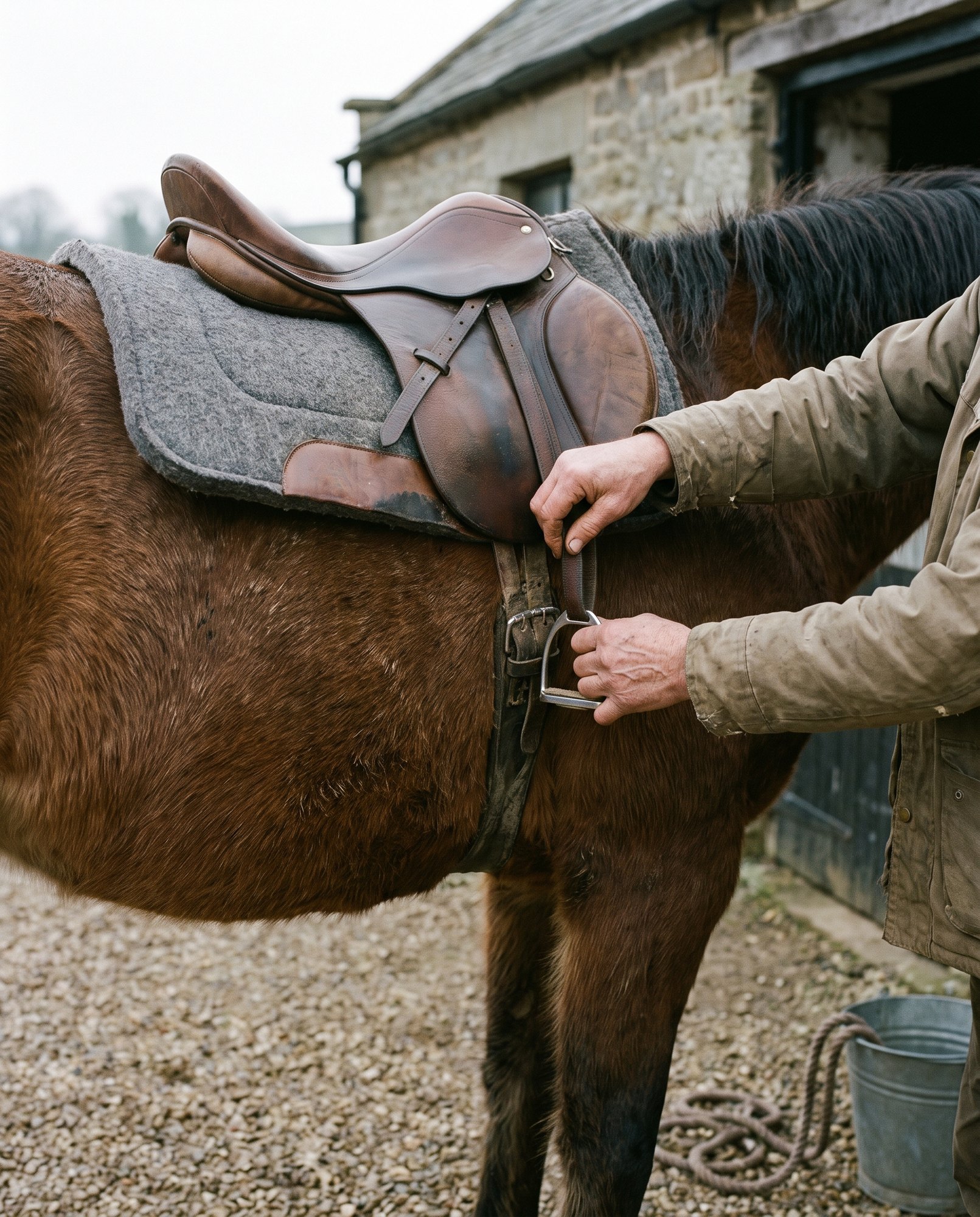
- A pressure mat (Pliance) with over 200 sensors records the load under the saddle at all gaits and shows it as a moving colour map; it measures what the hand under the panel cannot.
- Research links peak pressures above roughly 3 to 3.4 N/cm² and mean pressures above 1 to 1.3 N/cm² to back problems; the lumbar back tolerates far less than the withers; bridging is among the worst faults.
- The Society of Master Saddlers found mounting from the ground puts the most pressure on the spine and a high block the least; hand placement matters.
- Thermal imaging does not measure pressure and often shows the wrong side; use it as a question, not an answer.
- Ask a fitter for the map in motion, with your rider, pad and saddle, and compare two set-ups on the same horse the same day.
General editorial guidance. Pressure thresholds are research values that vary between systems and set-ups; a sore back, reluctance to be girthed or a change in the way of going needs a vet and a qualified saddle fitter.