The Stable That Watches at Night
If something happened in the night, I would know in the morning. That is what most of us believe. Colic does not keep those hours, and the measurement now does.
A halter that reads heart rate, breathing, activity and posture through the night and calls your phone at the early signs of colic or a cast horse. Stall cameras that watch water, feed, manure, rest and rolling and send an alert when the pattern breaks. Sensors that log the ammonia and heat in a closed barn. The technology of the monitored stable has moved from research into products in the last three years, and start-ups in the field are raising money. What the devices actually measure, what an alert means, where the research stands on cameras that recognise stress behaviour, and what a small yard on Mallorca gains and risks by installing them.
The night is the gap in every yard’s care, and colic is what fills it. A monitor buys the hours between the first sign and the morning check; it does not replace the person who then has to act.
The gap the night leaves
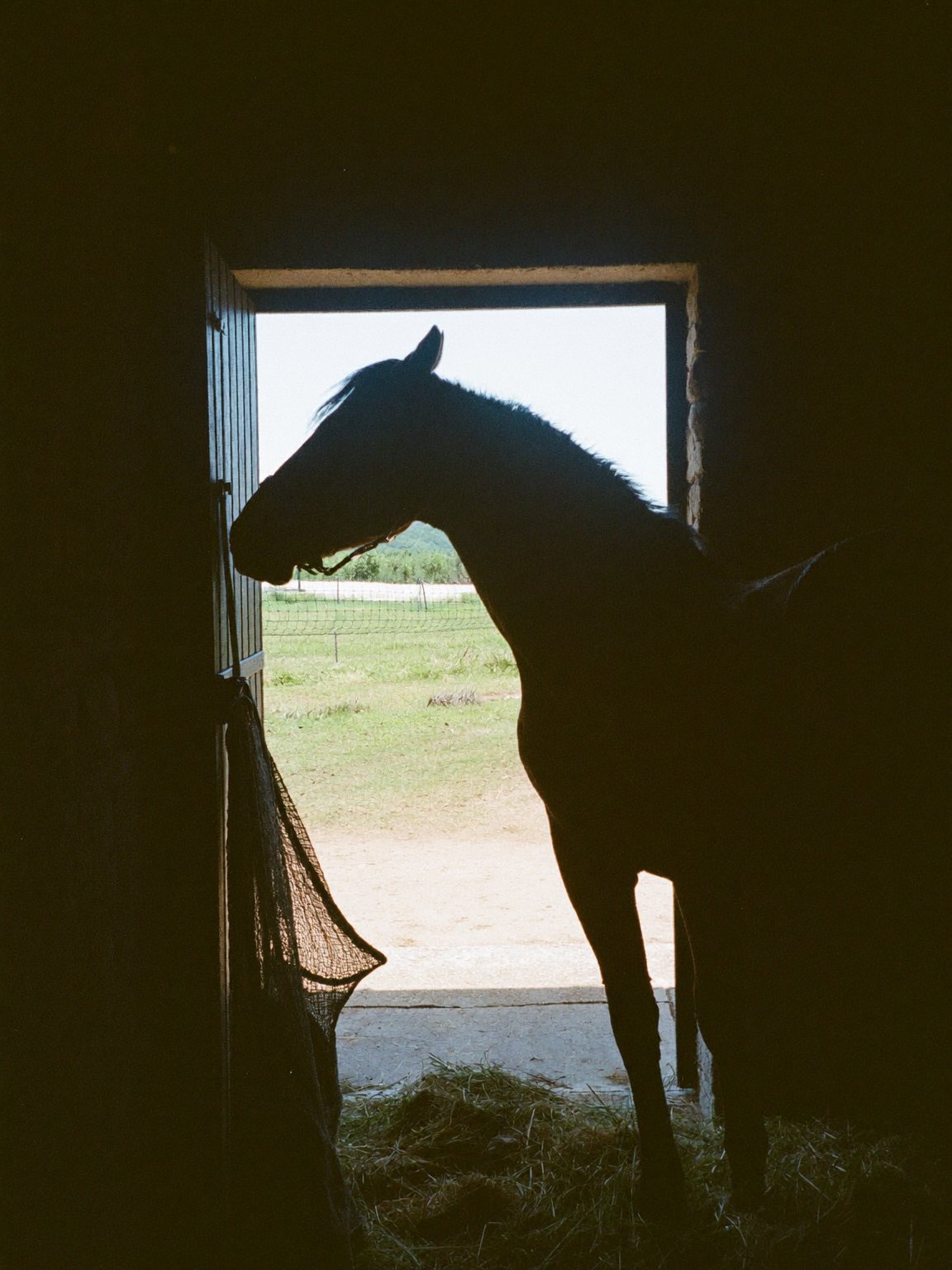
Most horses are checked last at evening feed and first at morning feed. Between those two visits lie nine or ten hours in which a colic can begin, a horse can get cast against a wall, a mare can foal, and nobody knows until the door opens. Colic is the leading medical killer of horses, and the outcome depends more on the hour it is found than on almost anything else. That gap is what the monitored stable is built to close.
Two families of device address it. One is worn by the horse and reads the body; the other is fixed to the stable and reads behaviour. Both end in the same place: a message on a phone at three in the morning.
The halter that reads vital signs
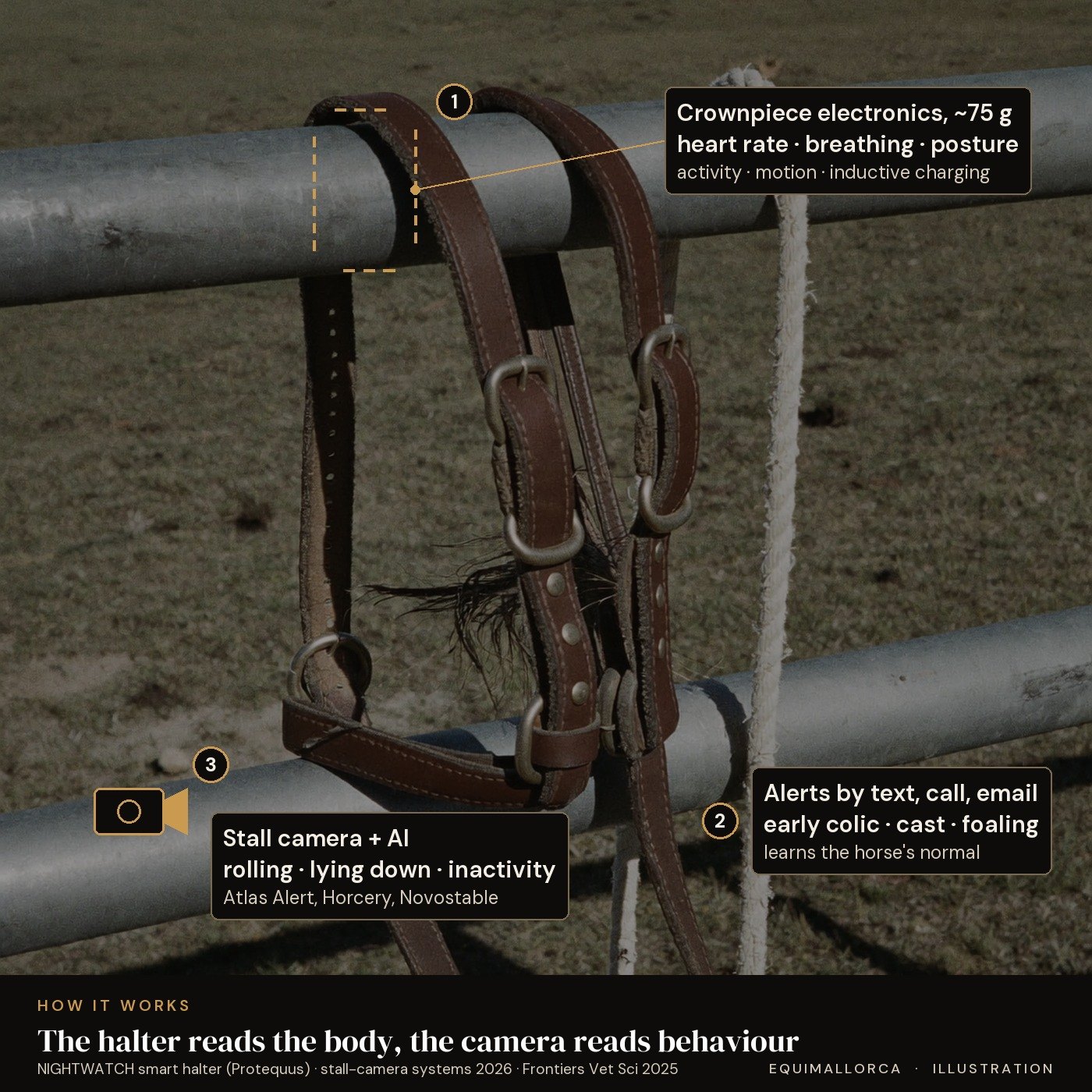
The best-known wearable is NIGHTWATCH, a smart halter from the Texan company Protequus that has been on sale for several years. About sixty grams of electronics in the crownpiece monitor heart rate, breathing rate, activity, motion, position and posture; the software learns the individual horse’s normal over time and raises an alert by text, phone call and email when the pattern shifts towards the early signs of colic, of a horse that is cast, or of foaling. It runs over cellular and Wi-Fi networks, which matters on a finca with one bar of signal.
The logic is a distress score built from several signals at once: a rising heart rate on its own is a horse that has heard something; a rising heart rate with restlessness, repeated lying down and a change in posture is the shape of the first hour of colic. The device does not diagnose; it notices the shape.
A rising heart rate alone is a horse that heard something. With restlessness and repeated lying down, it is the first hour of colic.
The camera that reads behaviour
The second family needs nothing on the horse. A camera in the stall streams to software that learns what this horse does at night and flags what it does not usually do: Atlas Alert watches water, feed, manure, rest and behaviour together as colic indicators; Horcery’s Stall Monitor reports rolling, lying down, unusual inactivity and people entering the stall; Novostable, Stable 1 and Starburst AI sell continuous monitoring with colic alerts, and Magic AI raised 1.2 million dollars in 2026 to expand its StableGuard system. Research groups are training the same kind of model to recognise stereotypies, cribbing and weaving, as welfare signals.
The strength of the camera is that it sees the whole stall and the whole night; the weakness is that it sees only what is in frame, in the light it has, on a network that stays up. A horse that lies down quietly to die of a twisted gut may trip nothing; a horse that rolls once for pleasure may trip everything. The makers all describe learning periods and adjustable sensitivity for that reason.
- NIGHTWATCH smart halter · about 2.7 oz (75 g) of sensors, processors and battery embedded in the padded leather crown; heart rate, respiration, activity, posture, motion; alerts by text, call and email; wireless inductive charging. US Equestrian feature
- Stall camera + AI · a camera per box streaming to software that flags rolling, lying down, inactivity and changes in water and feed; e.g. Atlas Alert, Horcery Stall Monitor, Novostable. Atlas Alert
The air in the barn
A third, quieter set of sensors measures the stable itself. Ammonia from urine, temperature and humidity are the variables researchers list for respiratory health in closed barns, and cheap logging sensors now record them around the clock. On Mallorca the closed barn is the summer problem more than the winter one: a block shut against the midday heat can hold ammonia and humidity at levels no one standing in it at feed time would notice.
This is the least glamorous measurement in the article and possibly the most useful. A logger that shows the box hitting thirty-four degrees at four in the afternoon changes where the horse spends the summer.
A 2025 editorial in Frontiers in Veterinary Science on technology for monitoring horse welfare lists wearables, camera-based behaviour recognition and environmental sensors as the three strands, and frames their combination, individual plus environment, as the direction of the field.
What a Mallorca yard gains and risks
The gain is the hours. A yard where the owner lives off site, a finca with two horses and no night staff, a mare due to foal in April: these are the situations where a device that calls at three in the morning changes the outcome. Delivery of the halter to the Balearics, a mobile signal in the barn, and a phone that is not on silent are the practical questions; a false alarm a week is the practical cost, and the makers say the false alarms fall as the software learns the horse.
The risk is the one that comes with every monitor: the feeling that the horse is watched, when what is watched is a signal. The device shortens the time to the phone call; the phone call still has to reach someone who can get to the stable and, if needed, a vet who can get there in the dark. On an island where the emergency vet may be an hour away, that second half of the chain is the one to organise before the first half is bought.
The night is the gap in every yard’s care. A monitor buys the hours; it does not replace the person who has to act.
- Between evening and morning feed lie nine or ten unwatched hours, and colic, the leading medical killer of horses, does not keep office hours.
- A smart halter (NIGHTWATCH) reads heart rate, breathing, activity, motion and posture, learns the horse’s normal and alerts by text, call and email at the shape of early colic, a cast horse or foaling.
- Stall-camera systems (Atlas Alert, Horcery, Novostable, Stable 1, Starburst, Magic AI’s StableGuard) flag rolling, inactivity, changes in water, feed and rest; research is training them on cribbing and weaving.
- Environmental loggers for ammonia, temperature and humidity are the cheapest measurement and, in a closed Mallorca barn in summer, possibly the most useful.
- A monitor shortens the time to the phone call; organise who answers it and which vet comes at night before buying the device.
General editorial guidance, not veterinary advice. Product features are as described by the makers in September 2026. Signs of colic, a cast horse or a foaling in difficulty need a vet at once, whether a device raised the alarm or a person did.