Twice as Likely: What a Year of Sensors on 700 Racehorses Found
An injury comes out of nowhere. That is what most of us believe. A year of data on seven hundred two-year-olds says it usually announces itself first.
The American Association of Equine Practitioners followed more than seven hundred two-year-old Thoroughbreds through a year of training with wearable sensors on their girths and saddles, and published the findings in 2026. Horses whose sensor reading turned yellow or red after a fast work were about twice as likely to go on to a musculoskeletal problem as horses that stayed green, and the risk climbed with every further flag. What the study did, what the sensors measure, why the result matters beyond racing, what it does not prove, and what it means for a sport horse on Mallorca.
A sensor does not predict an injury; it notices the change in movement that often comes before one. Twice the risk after a flag is a reason to look, not a diagnosis, and the same logic works without a sensor: any consistent change in how a horse moves is the earliest sign there is.
What the study did
The AAEP Wearable Biometric Sensor Research Project was a prospective study: it fitted sensors to young horses before anything was wrong and waited to see what happened. More than seven hundred two-year-old Thoroughbreds entering training in the United States wore devices from six companies during their breezes, the fast works that are the most demanding part of a racehorse’s week; four companies, Alogo, Arioneo, StableAnalytics and StrideSafe, delivered enough data to analyse. The study ran for a year, closed in December 2025, and was funded with more than nine hundred thousand dollars by racing’s own institutions, from the Breeders’ Cup to the Jockey Club’s research foundation.
Each sensor reported a status after each fast work: green, yellow or red. The study then matched those flags against the veterinary records of what happened to each horse afterwards.
What it found
Horses flagged yellow or red were about twice as likely to have a documented musculoskeletal issue as horses whose readings stayed green, and the likelihood rose progressively for horses that were flagged more than once. The sensors did not interfere with training. Half of the horses in the study went on to race as two-year-olds, against an industry average of just under forty per cent, which the AAEP reads as a sign that monitored horses were, at the least, not held back by being monitored.
The association’s own conclusion was measured: the sensors show potential as a tool for injury detection and prevention, and they need further refinement before anyone should think about mandating them. The lead data analyst, Dr Peta Hitchens, called for further prospective work to sharpen the accuracy.
A flag doubled the odds. Repeated flags raised them further. That is the shape of a warning, not a verdict.
What the sensors measure
The devices differ, but they share a core: an inertial unit records the stride, its length, frequency, symmetry and regularity, at speed; several add heart rate and an electrocardiogram, and GPS for speed and distance. Arioneo’s Equimetre, one of the four in the study, records heart rate, ECG, GPS and stride data in a single girth-mounted unit, and the British Horseracing Authority has piloted its heart-rate monitoring at the racecourse. StrideSafe is built around stride analysis alone. What each flag means is the company’s algorithm applied to a change from that horse’s own baseline.
That last point is the mechanism. A horse that shortens one side of its stride by a few per cent at a gallop is doing something no eye on the rail can see, and the change often comes days or weeks before the lameness that a vet can find.
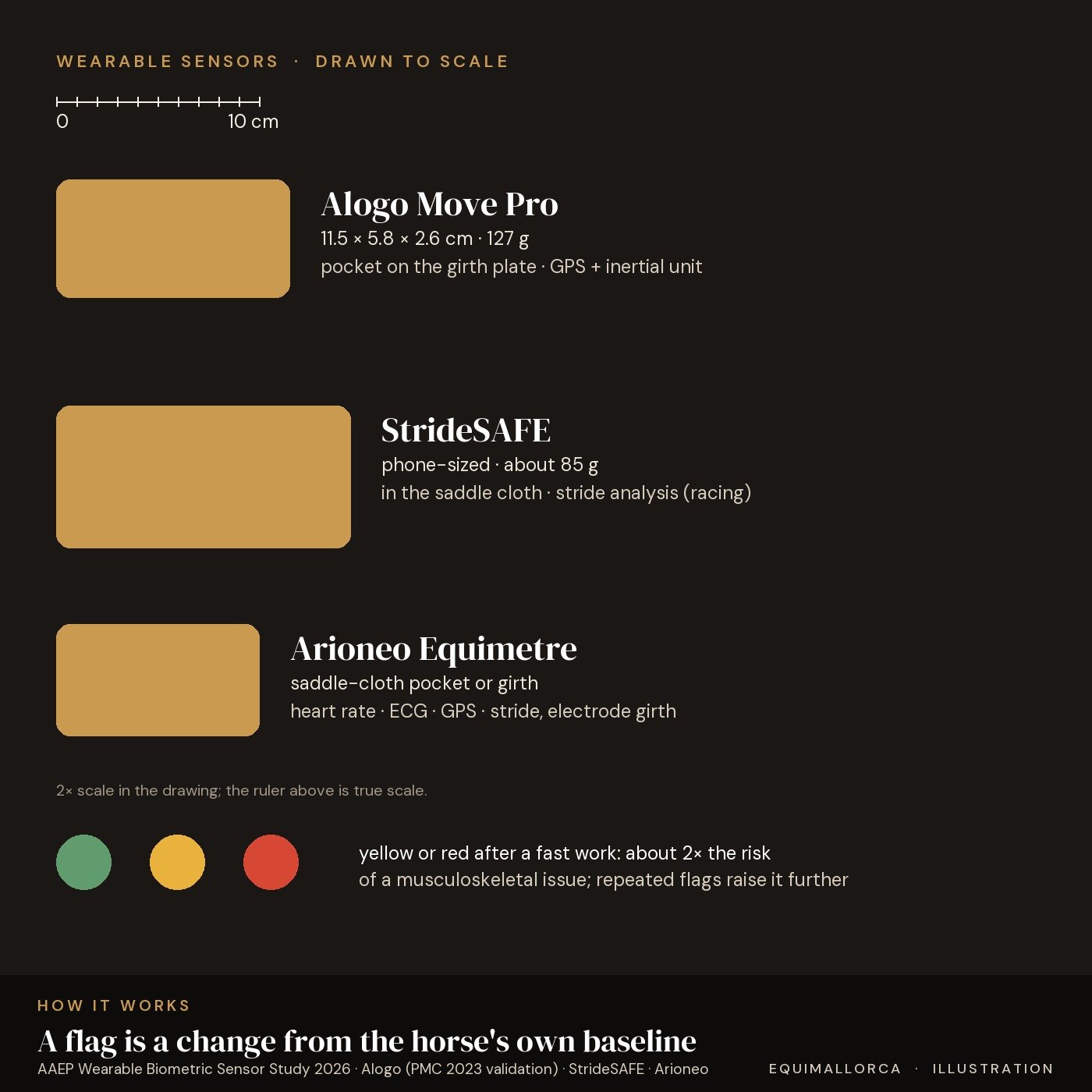
- Alogo Move Pro · 11.5 × 5.8 × 2.6 cm, 127 g, pocket on the girth plate; GPS and inertial unit; validated for gait and jumping. Validation study, PMC 2023
- StrideSAFE · phone-shaped sensor of about 85 g in the saddle cloth; stride analysis at speed; worn by every runner at Churchill Downs. StrideSAFE
- Arioneo Equimetre · sensor in a saddle-cloth pocket or on the girth, electrode girth under the pad; heart rate, ECG, GPS and stride data. Arioneo
What it does not prove
Twice the risk is not certainty: most flagged horses did not break down, and some green horses did. The study is racehorses at racing speeds, on American tracks, in a training system with daily fast works to measure; a dressage horse on Mallorca produces a different signal at a different intensity, and the algorithms were not tuned for it. Four of six companies delivered usable data, which says something about how young this technology still is. And the flags were compared with veterinary records, which depend on somebody noticing and writing it down.
The AAEP said all of this itself. The value of the study is that it is the first prospective test of the idea at scale, and the idea survived it.
What it means for a sport horse
The sensors are moving into sport: the same companies sell units for dressage, jumping and eventing horses, and the saddle clip in the coaching article of this series already flags changes in symmetry across sessions. For an owner on Mallorca the question is not whether to buy a girth sensor tomorrow but what the study proved about horses in general: a consistent change in movement is the earliest warning there is, and it usually comes before the horse is visibly lame.
That warning is available without electronics. The same handler trotting the horse up on the same track every week, a phone recording it, a farrier who says the feet have changed, a rider who notices the left canter has gone flat: these are the yard’s own yellow flags. The sensor’s contribution is that it never gets used to a horse. People do.
A flag, from a sensor or from your own eye, is a reason for a trot-up, a baseline comparison and, if it persists, a vet. The gait-analysis article in this series covers the phone-based tools that turn a trot-up into numbers.
The sensor’s contribution is that it never gets used to a horse. People do.
- The AAEP followed more than 700 two-year-old Thoroughbreds for a year with wearable sensors during fast works; four companies’ devices delivered usable data.
- Horses flagged yellow or red were about twice as likely to have a musculoskeletal issue than green horses; repeated flags raised the risk progressively.
- The sensors record stride length, frequency and symmetry at speed, often with heart rate, ECG and GPS; a flag is a change from the horse’s own baseline.
- Racehorse data on racing tracks: the algorithms are not tuned for sport horses, and the AAEP says the devices need refinement before any mandate.
- The general lesson holds everywhere: a consistent change in movement is the earliest warning, and it is a reason for a trot-up, a baseline and the vet.
General editorial guidance, not veterinary advice. A change in a horse’s movement, flagged by a sensor or seen by eye, needs a veterinary examination; no sensor diagnoses or rules out an injury.