The Coach in Your Pocket: What a Saddle Sensor Measures
Without a trainer on the ground, I ride blind. That is what most of us believe. The measurement now clips to the saddle and counts.
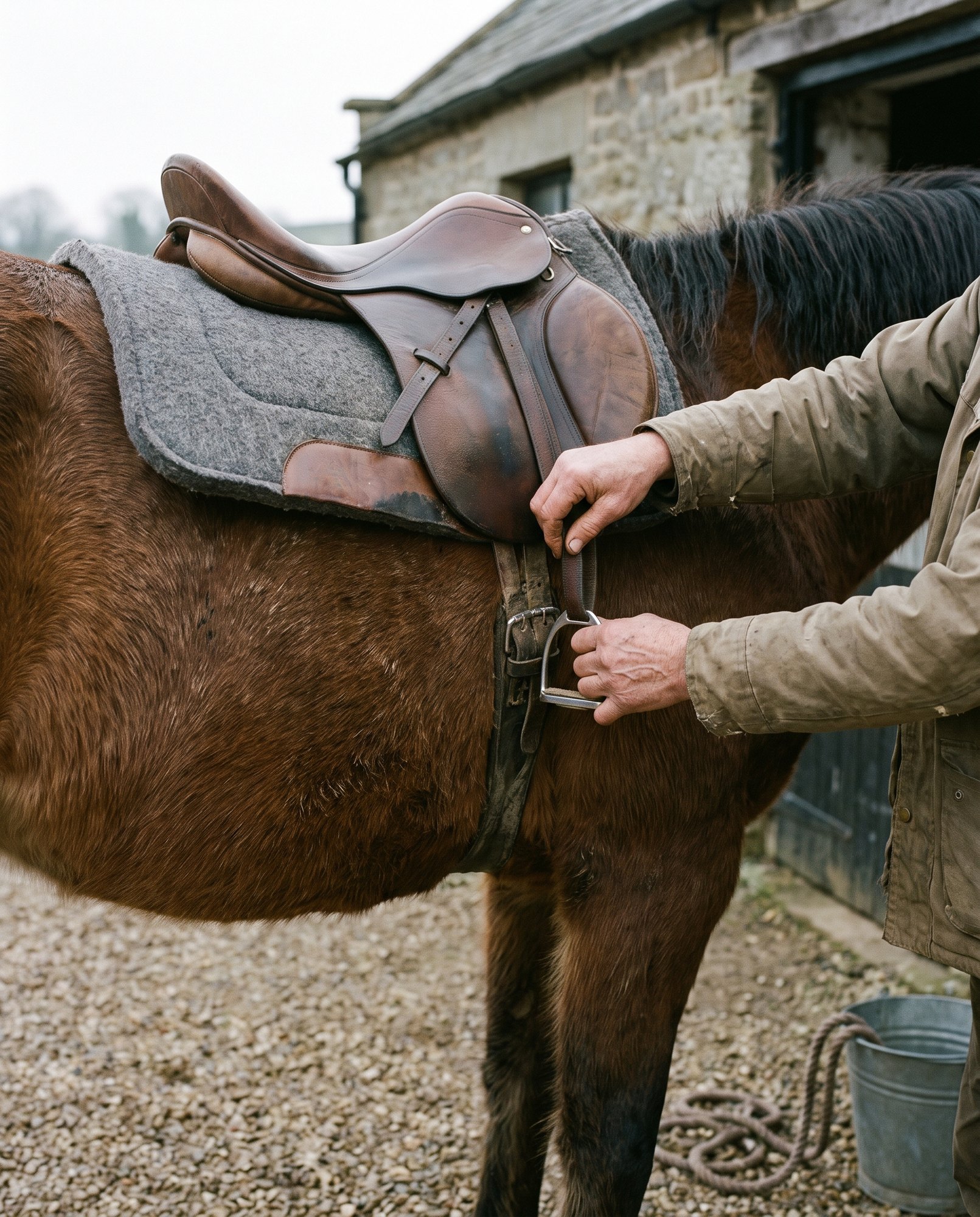
A sensor the size of a matchbox on the saddle flap records rhythm, symmetry, impulsion and how much of the session was ridden on each rein, in each gait, over how many jumps. In March 2026 the Dutch company behind it, Equestic, added an AI layer called EQ Coach-Copilot: the lesson is recorded, turned into a structured summary, and played back to the rider during the next solo ride. What the clip measures and what it does not, how the copilot works, what a rider on Mallorca without a weekly trainer can do with it, and the limits of a number for feel.
The clip measures what a coach counts from the ground: rhythm, symmetry, left and right, gaits and jumps. It does not measure feel. Use it to keep the trainer’s last lesson alive between lessons, and read a change over weeks, not a number on one day.
What the clip measures
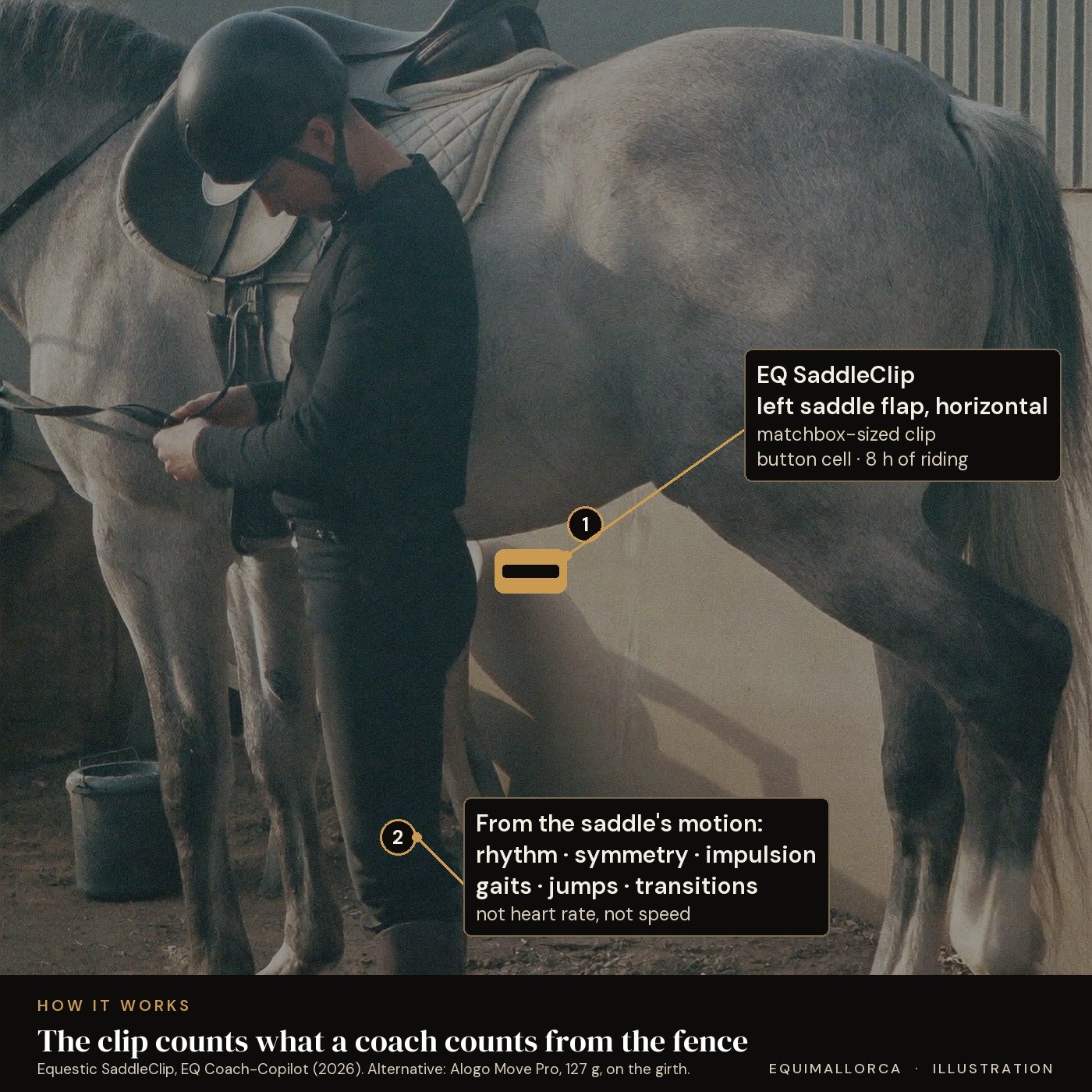
The Equestic SaddleClip is an inertial sensor that attaches to the saddle and talks to a phone. From the motion of the saddle it derives the things a trainer counts from the arena fence: the rhythm of each gait, the symmetry between left and right, impulsion, the balance of work on each rein, time in walk, trot and canter, the number of jumps, and transitions. The company adds an early-symptom function that looks for changes in symmetry across sessions.
None of this is new science; inertial sensors have measured horse movement in research for two decades. What is new is the packaging: a clip, an app, a session summary in the tack room five minutes after the ride, and a history that shows whether this week’s horse moves like last month’s.
What the copilot does
EQ Coach-Copilot, announced in March 2026, adds the trainer. The lesson is recorded as audio through the app, transcribed and structured into a summary of what the coach asked for; the recording itself is deleted once the summary is confirmed and, according to Equestic, not used to train models. The rider adds voice reflections after solo rides. The result is a training diary that lines the coach’s words up with the clip’s numbers.
During a solo ride the rider can ask the app to play the relevant part of the last lesson through connected speakers: the exercise, the correction, the coach’s phrasing. Coaches use the platform free; riders have a trial and then a membership priced by the number of horses. The company says thousands of riders and coaches use it across fifteen markets.
The clip counts. The copilot remembers. Neither one rides the horse.
- Equestic SaddleClip · clips to the left saddle flap, horizontal (max 45°); rechargeable button cell, about 8 hours of riding; measures gaits, left/right, jumps, rhythm, symmetry, transitions; no heart rate, no speed. Equestic FAQ
- Alogo Move Pro · 11.5 × 5.8 × 2.6 cm, 127 g, in a pocket on the girth plate; GPS plus inertial unit, validated for gait and jumping analysis. Validation study, PMC 2023
What a number can do for feel
A symmetry figure does not tell a rider how the horse felt, but it settles arguments with oneself. The horse that seems stiffer on the left rein either is or is not; the session that felt like a lot of canter either was or was not; the week that felt like progress shows up as a trend or does not. Riders who train alone lose this kind of honesty first, because there is nobody to say it.
The numbers are weakest as a verdict on a single day and strongest as a curve. A horse’s symmetry changes with footing, weather, tack and the rider’s own asymmetry; one reading proves little. Twenty readings over a month describe a horse.
The Mallorca use case
Many riders on the island train without a trainer for weeks at a time: the coach comes from the mainland once a month, or teaches one clinic a season, or the rider keeps a horse at a small finca with no arena mirror and no one watching. This is the rider the copilot is built for. One recorded lesson becomes four weeks of structured solo work, and the clip shows whether the work went where the lesson pointed.
It also fits the summer. Short early rides in July and August are easier to keep purposeful when the app knows the plan, and a symmetry curve that drifts after a hot month is a reason to look at the horse, not at the rider’s mood.
The clip reads the saddle, not the horse’s back or legs. A change in symmetry is a reason to have the horse looked at, not a diagnosis; the smartphone gait-analysis article in this series covers the tools that measure the horse itself.
Data, privacy and the coach
A lesson recorded on a phone is a conversation recorded on a phone. Equestic’s stated handling, transcription then deletion, no model training, is the right shape, and it is worth reading the terms before the first lesson is recorded, and telling the coach. Some trainers will welcome a client who arrives with a diary; some will not want their teaching turned into audio. That is a conversation to have in the yard, not in the app.
The tools do not replace the coach; they extend the coach’s reach into the weeks between visits. For a rider who has a good trainer once a month and an honest sensor every day, that is a better arrangement than most riders on the island have today.
One recorded lesson becomes four weeks of structured solo work. The clip shows whether the work went where the lesson pointed.
- The Equestic SaddleClip records rhythm, symmetry, impulsion, work on each rein, time per gait, jumps and transitions from the motion of the saddle.
- EQ Coach-Copilot (March 2026) records the lesson, structures it into a summary and plays the relevant part back during solo rides; recordings are deleted after the summary is confirmed.
- Read the numbers as a curve over weeks, not as a verdict on one day; symmetry changes with footing, tack and the rider.
- Built for riders who train alone between a trainer’s visits, which describes much of Mallorca.
- A drift in symmetry is a reason to have the horse looked at, not a diagnosis; tell your coach before recording a lesson.
General editorial guidance. Product features are as described by the manufacturer in September 2026 and change with updates; a change in a horse’s movement needs a vet, not an app.