The Scanned Hoof: Where the Printed Shoe Stands
A shoe is a shoe; the farrier shapes it to the foot. That is what most of us believe. The measurement is a handheld scanner, and the shoe that comes out of the printer was never a shoe for any other foot.
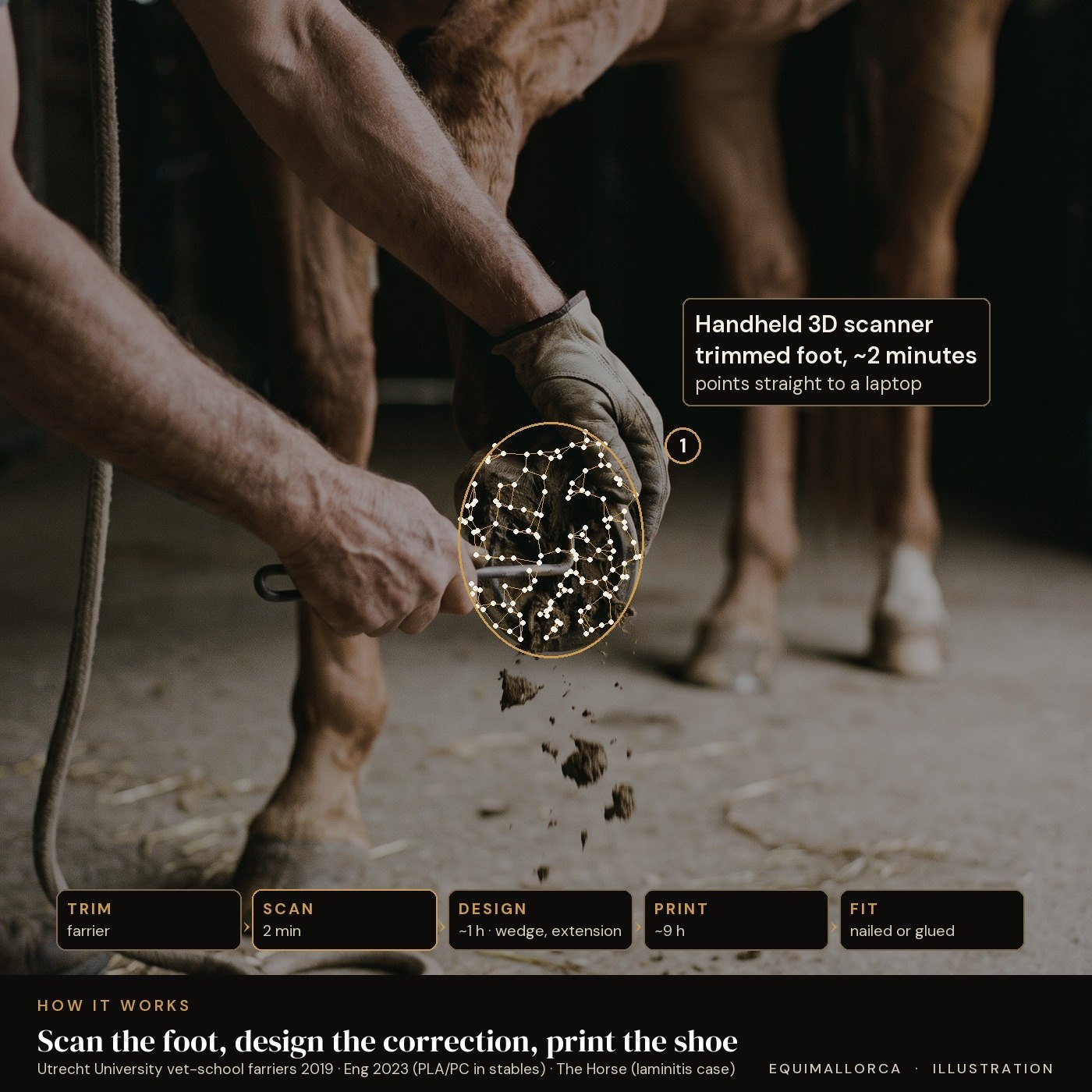
A hoof is scanned in a couple of minutes with a handheld 3D scanner, the shape goes into design software where a farrier adds a heel wedge, a branch extension or a rolled toe, and a printer builds the shoe overnight: nailed or glued, in nylon, polymer, or, for one racehorse in 2013, titanium. Utrecht’s veterinary faculty set up a scanning and printing trial with its farriers in 2019; a lameness clinic in Australia has rehabilitated laminitic horses in printed shoes; a 2023 study tested how printed plastics survive a stable. What the workflow does, which horses it is for, what it costs in time, what the material research says, and why the farrier’s hand is still the instrument that matters most.
The scanner measures the foot; the printer builds a shoe for that foot alone. It is a therapeutic tool for the lame, the deformed and the young, not a replacement for a good farrier on a sound horse, and on Mallorca the farrier still comes first.
Scan, design, print
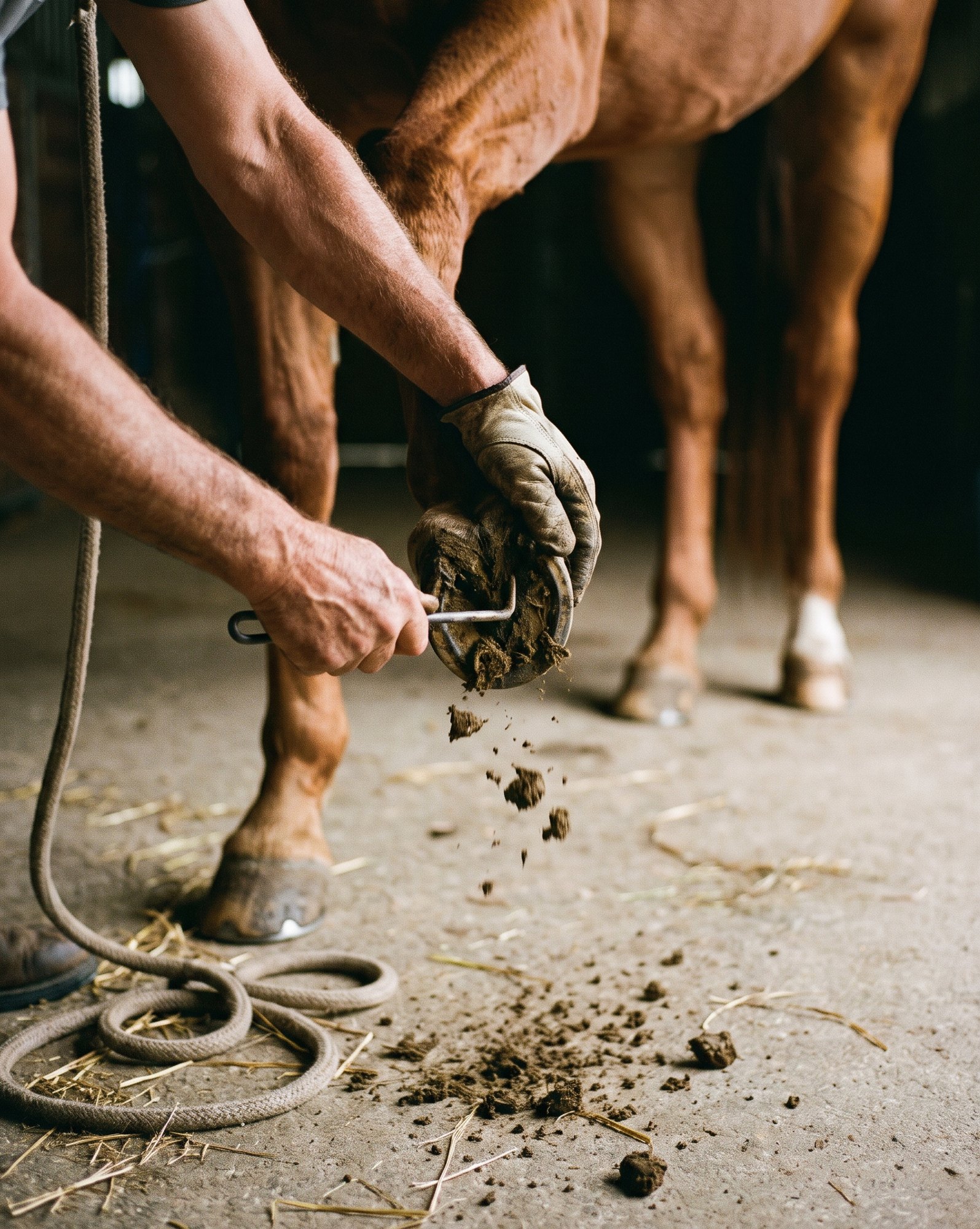
The workflow was laid out in public by the farriers of Utrecht University’s veterinary faculty in 2019. The foot is trimmed, then scanned with a handheld white-light 3D scanner that feeds points to a laptop; the scan takes a couple of minutes. In design software the farrier builds the shoe on the scanned hoof and adds what the case needs: a heel wedge, an extension on one branch, a rolled toe, a sole plate. The file goes to a printer, and the shoe is ready roughly nine hours later. From trimmed foot to finished shoe, about twelve hours, most of it printing.
The output can be nailed or glued according to the horse. Glue-on printed shoes leave the wall untouched, which is the reason they are used on feet that cannot take a nail: thin walls, laminitis, foals. The printed shoe is not a copy of a factory shoe in a new material; it is a shoe designed around this foot, on this day, with the correction built in.
Which horses it is for
The Utrecht trial targeted lame and conformationally challenged horses, foals with abnormal stance, and donkeys, whose feet differ enough from a horse’s that standard shoes fit them badly. In Australia, a veterinarian and farrier team at an equine podiatry and lameness centre in New South Wales has used printed shoes to move weight away from the painful parts of a laminitic foot, and reported a laminitic horse walking comfortably again in them. The common thread is a foot that a standard shoe, however well shaped, cannot serve.
That is the honest scope in 2026. Titanium shoes were printed for a racehorse in 2013 and made headlines; a working farrier in Oregon was printing his own shoes at home by 2016; but the routine sound sport horse on a six-week cycle is still shod from the anvil, and will be for some time, because the anvil is faster, cheaper and in the farrier’s van.
The printed shoe is not a factory shoe in a new material. It is a shoe designed around this foot, on this day, with the correction built in.
What the materials can take
A 2023 study in the journal Eng examined how glue-on 3D-printed plastic shoes degrade in the environment of a stable, and found that the strength of two common printing plastics, polylactic acid and polycarbonate, was not significantly affected by the conditions. That answers the first objection to a plastic shoe: it does not fall apart in bedding and urine within a cycle. Practitioners describe hybrid designs that combine a rigid printed frame for support, soft inserts for cushioning and a urethane layer where the shoe meets the wall.
Metal remains the material for wear. A printed polymer shoe on a horse doing road work on Mallorca’s lanes would not last the cycle; the same shoe on a laminitic horse in a deep-bedded box is exactly where it belongs.
- Handheld 3D scanner (e.g. Artec white-light scanner) · used by the Utrecht farriers: scanning takes a couple of minutes, design about an hour, printing about nine hours; the shoe can be nailed or glued. Hoofcare + Lameness, 2019
- Printed glue-on shoes (PLA, polycarbonate) · strength of both plastics not significantly affected by stable conditions in a 2023 test; hybrid designs add soft inserts and a urethane layer at the wall. Eng, 2023
What it does not replace
Every step of the workflow depends on the farrier: the trim before the scan decides what is scanned; the design decides what the shoe does; the fitting decides whether it stays on. A printer gives a good farrier a new tool for the hard cases and gives a poor one a faster way to make the same mistake. The scan itself is arguably the more useful half of the technology: a digital record of the foot, dated, that shows what six weeks or six months have done to it, which no photograph on a phone can.
For the owner the takeaway is not to ask for printed shoes but to ask whether the foot is being measured at all. A farrier who photographs the feet, records angles or scans them is building the baseline that every other measurement in this series depends on.
The Mallorca foot
The island’s feet have their own arguments. Dry, hard ground for seven months, then a short wet season that softens horn that has been rock since spring; stone tracks; a farrier who is a week’s wait. The EquiMallorca profile of Rafael Forteza, equine podiatrist and farrier on the island, describes a practice built on reading the foot by hand and by eye, and that practice is the one a scanner would serve, not replace.
If printed shoes reach the island for the laminitic pony in a Palma stable or the foal at a stud near Manacor, they will arrive through a farrier or a clinic who has scanned the foot first. The measurement comes before the shoe. That order will not change.
The farrier-visit checklist in the EquiMallorca magazine covers what to have ready, what to tell the farrier and what to ask, including whether the feet are being recorded between visits.
The scan is the more useful half of the technology: a dated record of the foot that shows what six weeks have done to it.
- Workflow (Utrecht, 2019): trim, scan in minutes with a handheld 3D scanner, design the shoe with the correction built in, print in about nine hours; nailed or glued.
- Scope in 2026: lame and conformationally challenged horses, laminitic feet, foals, donkeys; the sound sport horse is still shod from the anvil.
- A 2023 study found the strength of common printing plastics (PLA, polycarbonate) was not significantly affected by stable conditions; metal remains the material for wear.
- The farrier decides everything: the trim before the scan, the design, the fitting. The scan’s dated record of the foot may be the most useful part.
- On Mallorca the foot is read by hand first; a scanner serves that practice. Ask whether the feet are being measured between visits.
General editorial guidance, not veterinary or farriery advice. Therapeutic shoeing, including printed or glue-on shoes, is a decision for the vet and the farrier together, on the individual foot.