The Computer Reads the Face: AI and Equine Pain
A machine cannot read a horse. That is what most of us believe. The measurement is a model trained on the Horse Grimace Scale, and in August 2026 it started showing its working.
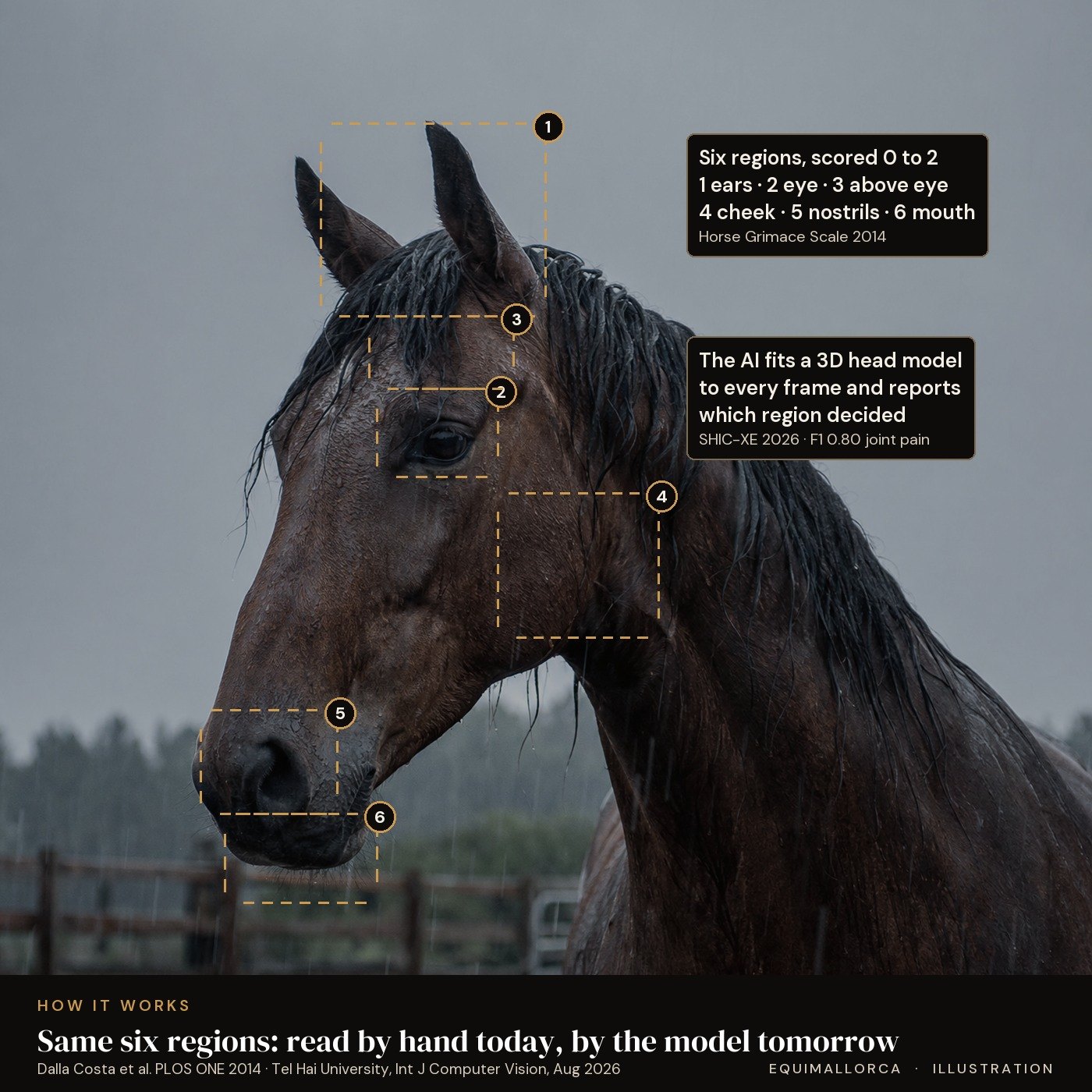
In August 2026 the International Journal of Computer Vision published a system from Tel Hai University in Israel that detects pain in horses from video and, for the first time, points to the parts of the face that decided it. It maps a three-dimensional horse model onto every frame so that its attention stays on the ears, eyes, cheeks, chin, nostrils, forehead and nose bridge as the horse moves, the same regions the Horse Grimace Scale scores by hand. On joint inflammation it reached an F1 score of 0.80; on post-surgical pain 0.67. What the system does, what the numbers mean, why explainability is the point, what the small samples do not allow, and where a stable camera on Mallorca meets this research.
The AI reads the same six signs a trained person reads, faster and without tiring, and it now says which sign it read. It is research on dozens of horses, not a product; the scale it learned from is the one you can use today.
What the system does
The work comes from the artificial intelligence systems engineering programme at Tel Hai University in Kiryat Shmona, led by Dr Marcelo Feighelstein, and builds on a decade of research into automating the Horse Grimace Scale. Earlier models classified pain from still images and, when asked why, produced heat maps that drifted across the frame as the horse moved. The new system, called SHIC-XE, fits a three-dimensional model of a horse’s head to each video frame so that anatomical regions, ears, eyes, cheeks and cheek muscles, chin, nostrils, forehead and the bridge of the nose, are tracked consistently, and the model’s attention is reported region by region.
The output is two things: a judgement, pain or no pain, and a map of which regions carried the judgement. That second output is what makes it possible to check the machine against a person who knows the scale.
What the numbers mean
The system was tested on three sets of footage: horses filmed before and after routine castration, thirty-nine of them; horses with induced joint inflammation, six; and horses given a brief physical stimulus to the lip, eleven. The F1 scores, a single figure that balances how many pain cases were caught against how many false alarms were raised, were 0.67 for post-surgical pain, 0.80 for joint inflammation and 0.70 for the lip stimulus. An F1 of 1.0 would be perfect; 0.5 is roughly the level of guessing on a balanced set.
Read plainly: on the clearest case, an inflamed joint, the model was right most of the time; on the messier case, the hours after surgery, it was right more often than not. That is where a trained human observer with the Grimace Scale also sits, and it is not yet where a vet with hands on the horse sits.
On an inflamed joint the model was right most of the time. On the hours after surgery, more often than not. That is where a trained observer sits too.
- SHIC-XE (Tel Hai University) · explainable pain detection from video; 3D head model fitted per frame; F1 0.80 joint inflammation, 0.70 lip stimulus, 0.67 post-surgical; research, not a product. Earth.com on the IJCV paper, Aug 2026
- Horse Grimace Scale · six facial action units scored 0 to 2 by a trained observer; the manual method the models are trained on. Dalla Costa et al., PLOS ONE 2014
Why explainability matters
A model that says pain and cannot say why is a black box, and a black box cannot be trusted on a welfare decision. The Tel Hai team’s own framing is that the point of SHIC-XE is to show whether the evidence the model used makes sense to experts. When the region map lights the orbital area and the ears on a horse a vet would also score there, the model is reading the face; when it lights the background or the noseband, it is reading something else, and the case is thrown out.
For anyone who has used the Grimace Scale by hand, this is the familiar discipline made mechanical: score the regions, not the impression. The earlier article in this series on the scale covers the six signs; the machine is learning the same six.
What dozens of horses cannot tell you
The authors list the limits and they are real. Thirty-nine, six and eleven horses are small samples; the veterinary comparison used carefully chosen side-view images rather than the messy footage of a stable; the method depends on the three-dimensional model fitting well, and extreme head positions or unusual breeds could send its attention to the wrong place; and there was no direct comparison with simpler tracking methods that might do nearly as well. None of this is a flaw in the idea. It is the gap between a paper and a product.
It also means the system has not been tested on the horses most owners worry about: the one with a quiet, chronic back problem, the one that is dull rather than grimacing, the one whose face has always looked worried. Those are the cases where a scale, human or machine, needs a baseline for the individual horse.
Where the stable camera meets the research
The stable-camera companies described in the companion article on the monitored stable already sell behaviour recognition: rolling, lying down, restlessness, changes in eating and drinking. Facial pain scoring is the obvious next layer, and research of this kind is what would make it credible. A camera that watches the face of a horse alone in its box at night is also, as it happens, exactly the observation the Grimace Scale asks for, since horses hide pain when a person is present.
For an owner on Mallorca, none of this is for sale yet in a form worth buying, and that is fine. The research is a strong argument for the thing that is free: learn the six signs, look when the horse is alone, write down what you see with the date, and call the vet on a pattern. The machine is being trained to do what a good owner already does.
The Horse Grimace Scale (Dalla Costa et al., 2014) scores six facial action units from 0 to 2. Our explainer lists them with what each looks like and when a pattern means the vet.
The machine is being trained to do what a good owner already does: look at the face when the horse thinks it is alone.

- SHIC-XE (Tel Hai University, International Journal of Computer Vision, August 2026) detects pain in horses from video and reports which facial regions decided it.
- It maps a 3D horse model onto each frame so attention stays on ears, eyes, cheeks, chin, nostrils, forehead and nose bridge, the Grimace Scale regions.
- F1 scores: 0.80 for joint inflammation (6 horses), 0.70 for a lip stimulus (11), 0.67 for post-surgical pain (39); right most of the time on the clearest case.
- Limits named by the authors: small samples, selected side-view images, dependence on the 3D fit, no comparison with simpler methods; a paper, not a product.
- The free version works today: learn the six signs, observe the horse alone, record with the date, call the vet on a pattern.
General editorial guidance, not veterinary advice. The system described is published research, not a diagnostic product; a horse showing repeated facial signs of pain, or a change in behaviour, needs a vet.
Six Signs on the Face
The Stable That Watches at Night