Cooling a Hot Horse: Keep the Water On
Hose, scrape, repeat. Scraping pulls the heat off. That is the habit on almost every wash bay. The measurement says scraping changes nothing.
In 2020 a Japanese research team led by Yuji Takahashi compared five ways of cooling Thoroughbreds after work in hot, humid conditions and published the results in the Journal of Equine Veterinary Science. Continuous hosing with cold water cooled the horses fastest. Whether the water was scraped off or left on made no measurable difference. Walking and a fan were the slowest. What the study did, what it found, what it means on a Mallorca wash bay in August, and the one thing the scraper is still good for.
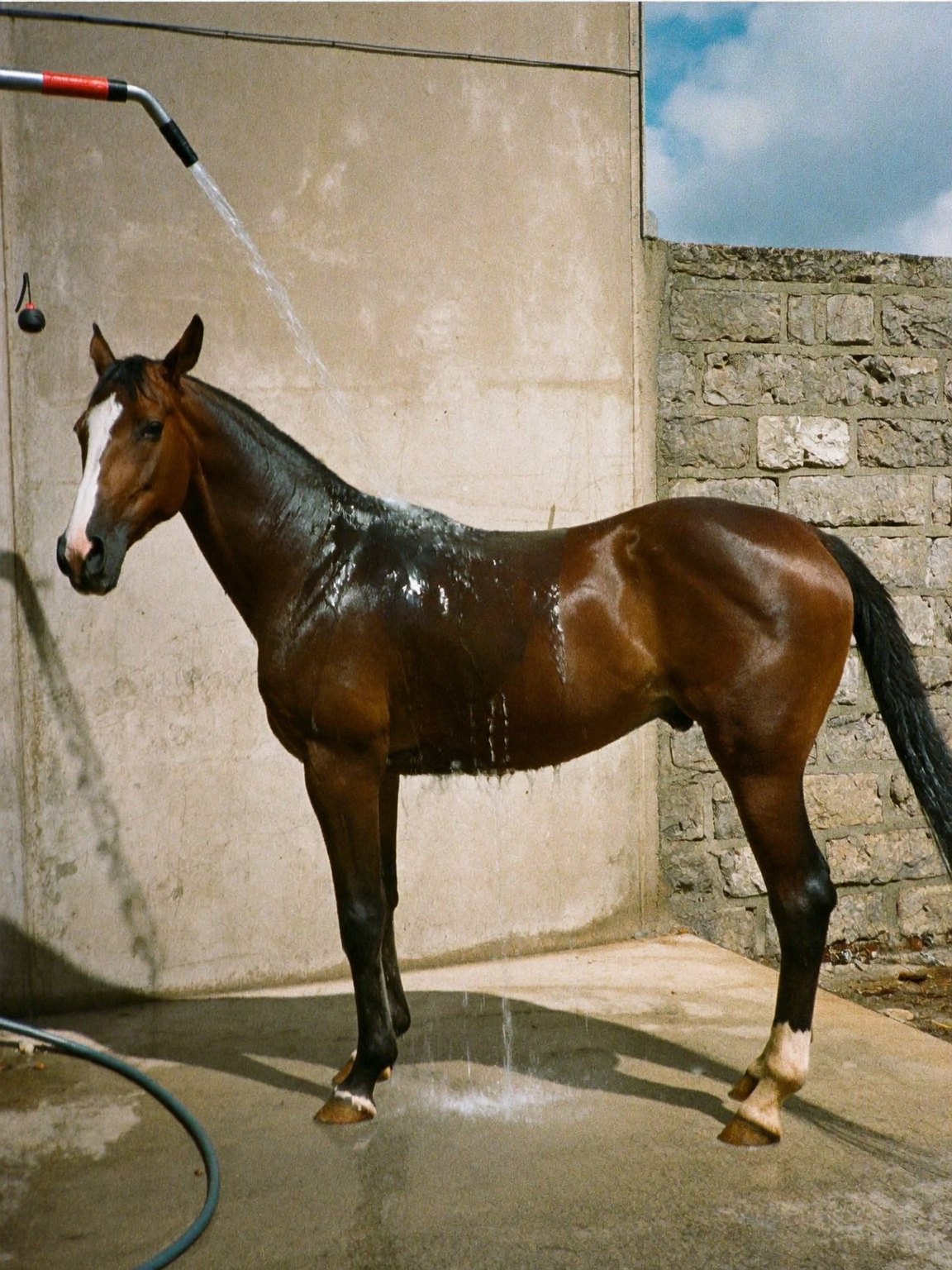
Keep the hose running over neck, chest and hindquarters until the breathing settles. Pouring, waiting and scraping is the slow version of the same thing.
What the study did
Takahashi and colleagues took Thoroughbred racehorses, worked them in hot and humid conditions, and cooled them by one of five methods while measuring body temperature as it fell: walking only; standing in front of a fan moving air at three metres a second; cold water poured on and scraped off, repeated every three minutes; cold water poured on and left on, repeated every three minutes; and a continuous shower of tap water for thirty minutes.
It was a small, controlled comparison on fit horses, which is exactly the situation of a sport horse coming off the arena on a summer afternoon. The horses were hot in the way a horse is hot after real work, not after a walk.
What it found
Continuous water was the clear winner. The horses under the running shower cooled fastest, and the researchers reported the rate as several times faster than the intermittent methods. Cold water left on the horse and cold water scraped off cooled at the same rate: scraping made no difference to how quickly the horse’s temperature came down. Walking alone and the fan were the slowest.
Kentucky Equine Research, summarising the study, put it plainly: continuous application of cold water is the quickest way to cool a horse, and scraping the water off is not essential.
Water left on and water scraped off cooled at the same rate. The scraper was never the cooling.
Why scraping does not matter
The old reasoning was that water sitting on the coat warms up and insulates the horse, so it must be removed before the next application. The measurement shows the warm film is not the problem: what cools the horse is the constant exchange of warm water for cold at the skin, and the fastest way to get that is to never stop. Scraping between applications interrupts the exchange without adding anything. The idea that cold water on hot muscle causes cramp or tying-up is not supported by the study, which applied cold water directly to hot, working racehorses.
The scraper keeps one job: at the end, once the breathing has settled and the horse is going back to a stable or a paddock, scraping the surplus off means the horse dries faster and the wash bay is not walked through the yard. That is a tidiness argument, not a cooling one.
The wash-bay routine
After a summer ride on Mallorca, straight to the wash bay before the untacking is finished if the horse is blowing. Hose running, not the bucket. Neck, chest, between the front legs, the hindquarters and the inside of the thighs, where the big blood vessels sit near the skin. Keep the water moving over the horse and keep it coming, and watch the breathing rather than the clock. When the flanks stop heaving and the nostrils settle, the job is done; a last pass with the scraper and the horse goes to shade with water.
A horse that does not like the hose is cooled the same way with buckets thrown continuously, one after the other, rather than one bucket and a wait. Cold tap water is enough; the island’s summer tap water is not cold, and the study used tap water. Ice is not needed for a horse that is merely hot; it belongs to the emergency below, and even then water in quantity beats ice in small amounts.
A fan helps a horse standing in a stable through a hot afternoon, because moving air lets sweat evaporate. It is a poor substitute for water on a horse that has just worked. Use the fan after the hose, not instead of it.
When cooling is an emergency
A horse whose breathing does not settle within minutes of stopping, that sweats weakly or not at all, that is dull, wobbly or unwilling to move, is in heat stress and the routine above becomes an emergency: shade, water on the big muscles continuously, and somebody on the phone to the vet while it runs. Do not stop cooling to wait and see. The heat article in this series covers why a horse gets there so much faster than the person riding it.
For the ordinary hot horse, the study’s message is a relief. The fastest method is also the simplest: a hose, a tap and no interruptions.
The fastest cooling method is also the simplest one. A hose, a tap and no interruptions.
- Takahashi et al. (J Equine Vet Sci, 2020) compared five cooling methods on Thoroughbreds in hot, humid conditions.
- Continuous hosing with cold water cooled fastest; water scraped off and water left on cooled at the same rate; walking and a fan were slowest.
- Keep the hose running over neck, chest and hindquarters until the breathing settles; the scraper is for drying at the end, not for cooling.
- Cold tap water on a hot, working horse was used directly in the study; ice is not needed for a horse that is merely hot.
- Breathing that does not settle, weak sweat, dullness: continuous water and the vet on the phone while it runs.
General editorial guidance, not veterinary advice. A horse whose breathing does not settle, that sweats weakly or is dull after work in the heat needs continuous cooling and a vet at once.